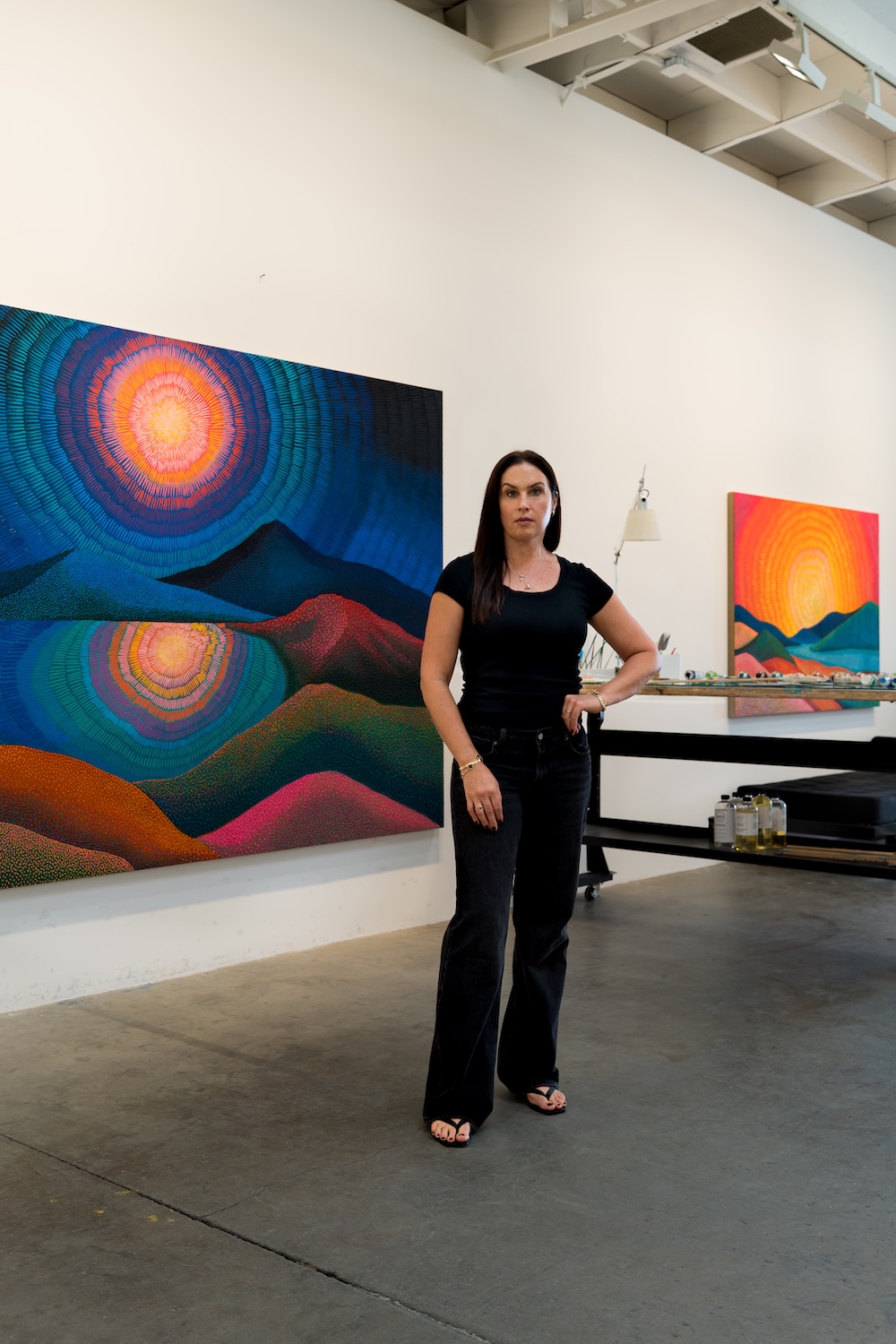
Late in the day, the light in Los Angeles turns to a kind of gold that feels almost weightless. In Jennifer Guidi’s studio, that light seems to settle into the surfaces of her new paintings—layered fields of color and sand that shimmer between the material and the immaterial. The works that will make up California Dreaming, opening at David Kordansky Gallery on November 7, belong to this light, to this place, and to the long arc of Guidi’s pursuit of presence.
For more than a decade, she has built her language from the ground up—literally—with sand as both substance and metaphor. In these new landscapes, that ground opens into space. Mountains rise, oceans vibrate, and horizons tilt toward the infinite. Each painting seems to hold its own temperature, its own frequency. They are not depictions of what is seen, but of what seeing feels like.
Guidi’s return to landscape is, in many ways, a return to origin. She grew up in the California desert, where the horizon never ends and the mountains feel close enough to touch. In California Dreaming, that childhood vastness becomes both memory and method. The paintings are meditations on perception itself—how attention can shift from the outer world to the inner one and back again, until both dissolve into color and light.
Speaking with Art Summit, Guidi reflects on that movement between worlds. She talks about time, intuition, and the quiet spiritual charge that runs through her work. At a moment when everything feels fractured and fleeting, her paintings offer something elemental: the stillness that exists within change, and the beauty that remains when we allow ourselves to look slowly.
An Interview with Jennifer Guidi
By Carol Real
How did California Dreaming begin? Was there an image, memory, or feeling that first sparked this new body of work?
Each body of work is connected to the last, so it’s really an ongoing flow of what I’m working on at the time and what’s naturally coming into the work. When I sat down to think about your questions, I realized that, as an artist, I’m in my head most of the time, and the only moment I really stop to look at the progression is before a show—knowing that I might have an interview or that I’ll be speaking with people at the gallery.
This body of work is the second show I’ve done that focuses only on landscape, without any purely abstract pieces. It’s also the first time I’m not using what I call “sand mandalas,” which are the more sculptural paintings where I make holes into the surface.
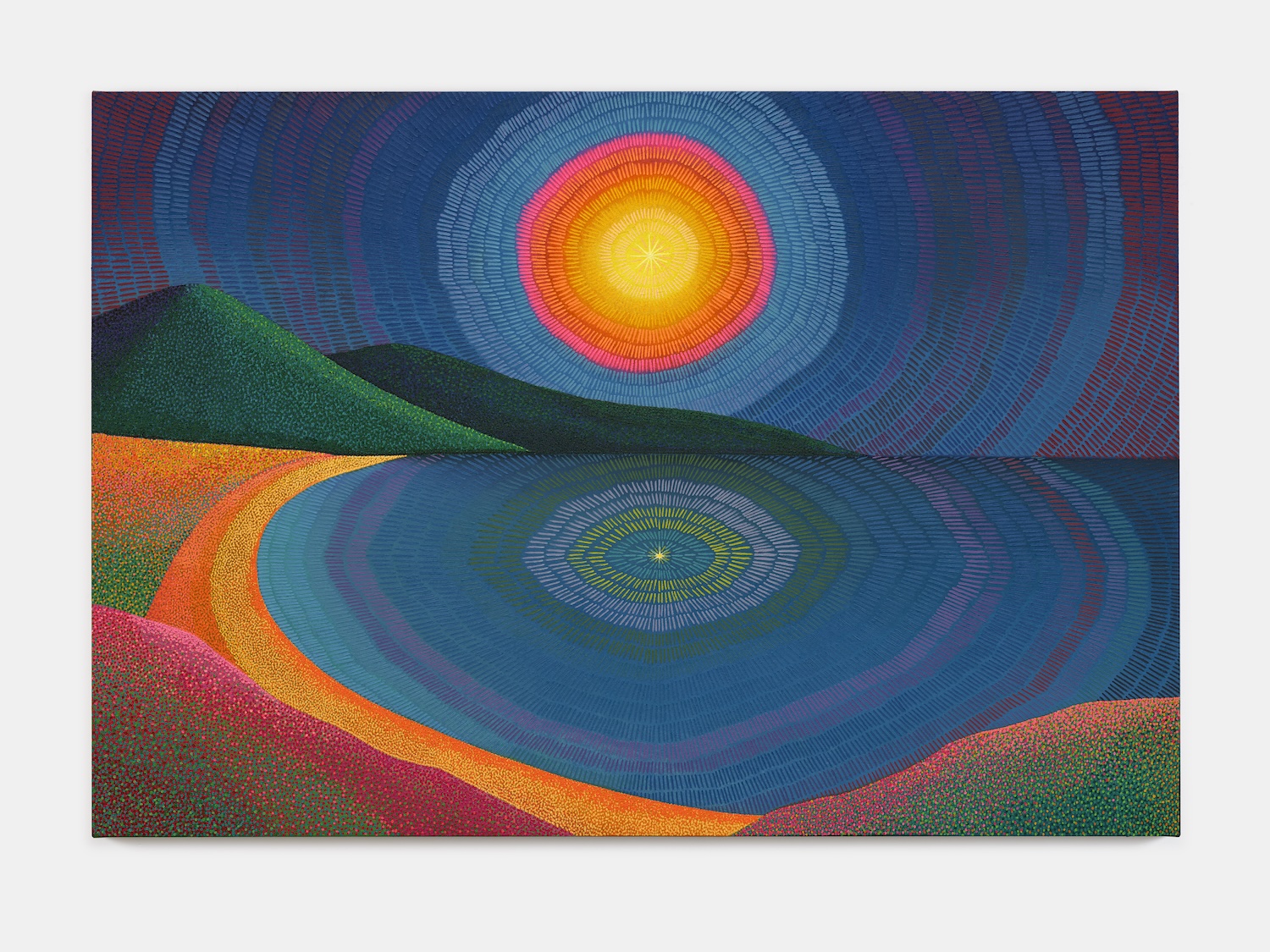
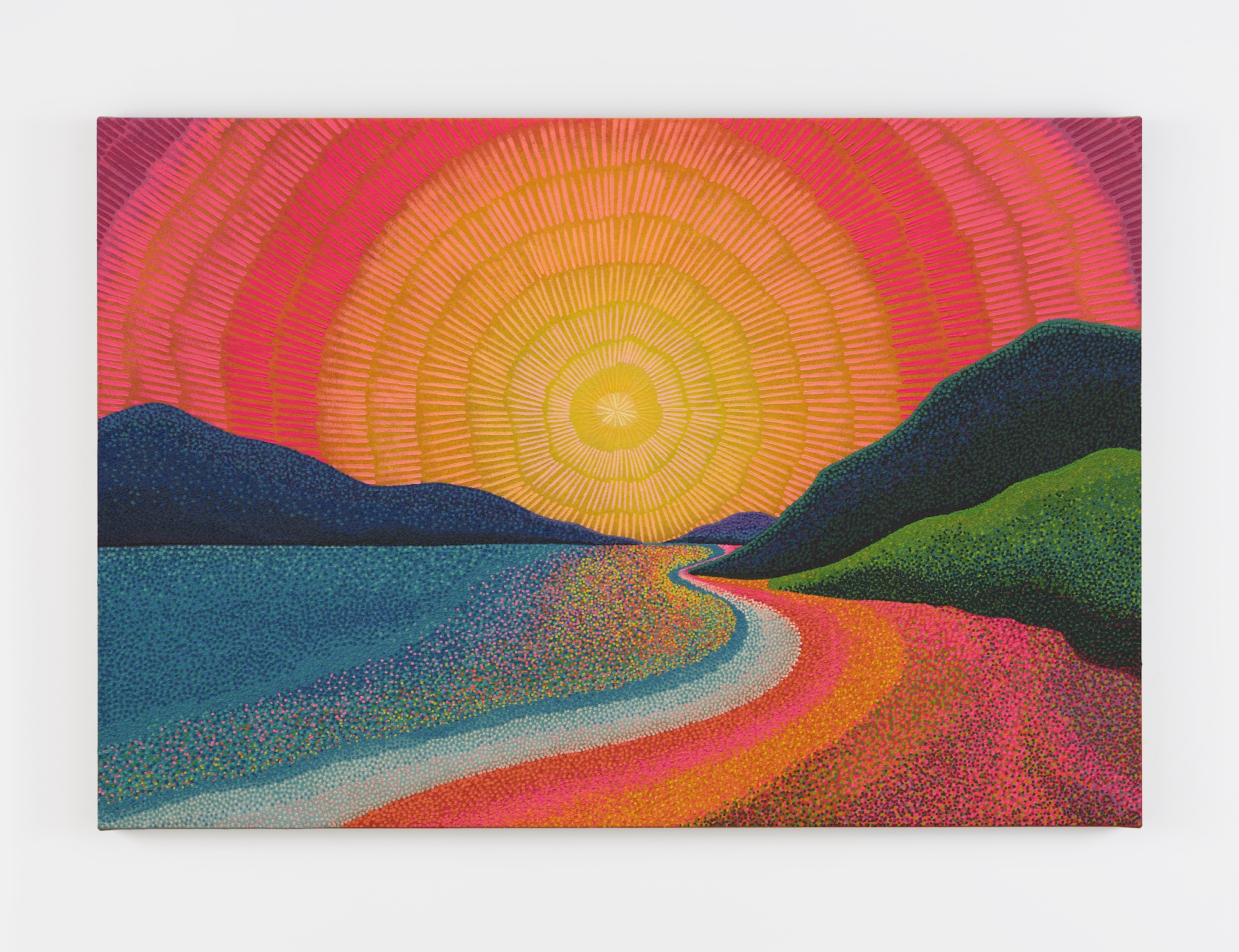
These come out of what I call “universe mandalas,” which begin with a sand ground. Then I paint the mandala with marks of oil paint and a brush. The landscapes grow out of that practice. In these works, the compositions open into more of an actual scene or world. In earlier ones, when I painted mountains, you would mostly just see the peak. I wasn’t trying to represent a real mountain—it was more about the play of color, light, and form.
Sand has long been at the heart of your work. How does it function in this new series, where the surfaces seem to echo both earth and light?
In these paintings, the sand begins as a ground on the canvas. Sand first started coming into my work around 2011 or 2012. The first time I used it, I mixed it into the oil paint. I had always been drawn to paintings that included sand—whenever I saw a little bit of it in a work, whether by Picasso, Kandinsky, or Alberto Burri, there was something about that texture that caught my eye. It was an idea that kept returning over the years: What can I do with sand?
I think that kind of inspiration is like a thought that wants to come out. If you listen closely enough, eventually it will. So it began with mixing sand into paint. Then, when I was making my early dot paintings—my first real journey into abstraction—I started rubbing sand onto some of them. It was almost like using it as grout on tiles. I was thinking: How can I add sand to this?
Eventually, I began wondering, how can sand itself become a painting? How can that material stay adhered, and how can I make marks into it? It evolved from there to what I’m doing now. You can still see traces of sand through the paint in the new works, but it’s not as much of a physical presence.
I still love the idea of using something from the earth to ground these paintings. Because they’re landscapes, it feels right that the material itself comes from the earth, while I’m painting images about the earth and our landscape.
Did you experiment with new materials, scales, or techniques while creating these paintings?
Not new materials, but definitely a new scale. I’m working with landscape formats this time—there aren’t any verticals in this show, even though I’m usually drawn to them. I liked the idea of staying entirely within the realm of landscape. So really, it’s about new sizes rather than new materials.
Your process is very time-based. How does the sense of time shift when you’re working on these immersive, layered surfaces?
They’re very time-consuming, and I think that process brings me to a certain mental space—into that zone of being fully immersed in a painting. It’s very physical and challenging. I believe that when we push ourselves beyond what we think we can do, whether it’s in sports or in any activity that requires both physical and mental effort–something shifts. You slip into that mindset of being in another place, of being in the zone, for lack of a better word.
How did you develop the compositions for this series? Did you begin with a structure or allow each work to unfold intuitively?
For the most part, in this body of work, I started by making sketches—partly from imagination, partly from photographs—and then quickly drew them onto the canvas, blocking in large shapes and colors just to get that initial image down. From there, it becomes a very intuitive process. I assign certain mountains different colors, and the mandalas I’m painting—whether they represent the sun, the moon, or reflections in water—evolve as I work.
They can change after I paint them. If something doesn’t feel right, if the color isn’t working, I’ll keep repainting the marks until I reach the right shade, the right feeling, the right intensity. Sometimes the whole composition shifts. There are a few paintings in this series that began as only mountains, and later I decided to add water. I scraped off the dots I had already painted—sometimes even sanded them down—and repainted the area.
Nothing is set. It depends on whether it feels like it’s working. And what “working” means for me is simply what resonates—whether the color, the shape, and the feeling reach that point where I no longer see anything that needs to be changed. When that moment comes, I just know. It’s there.
Were there particular sources of inspiration—visual, musical, or literary—that resonated with you during this period?
For me, my inspiration definitely comes from living in California—the landscape, the mountains I see every day. I live near Griffith Park, so I’m at the foothills of the mountains, and I often hike those trails. That connection to nature and the way it makes me feel as a human is very present in my work.
It’s also part of a spiritual journey that I’m on. Over the past year, one change in my process has been that instead of listening to music while I paint, I’ve started listening to audiobooks. As I paint and search for what I feel I’m meant to express, I’m also listening and learning, using that time to deepen my spiritual practice and my understanding of myself.
California has such a symbolic presence in art and imagination. What drew you to revisit it now, both personally and creatively?
When I turned to abstraction, there was a kind of emptying out of the imagery I had been painting before. Back then, I was painting scenes from my everyday life—simple, ordinary things like plants, flowers, and the apartment buildings in my neighborhood.
When I moved back to Los Angeles in 2001, I was struck by the feeling of the city—the light, the color—and I painted that for a long time. My first two solo shows in Los Angeles at ACME Gallery came from that body of work. Over time, though, I began to turn inward. I started reflecting more deeply on who I wanted to be, and that introspection came through meditation. Through that practice, I let go of imagery and color and began again, starting from a place of stillness.
Those early meditative paintings were the beginning of that journey, more than ten years ago. After all this time, it feels like things have come full circle. I’ve returned to the imagery I loved at the start—things that I now recognize as deeply personal and connected to memories from my childhood.
Most of my childhood was spent in Palm Desert. Recently, I drove back to the house where I grew up, and I was really struck by the mountains that had been my backyard. I realized I had spent most of my childhood outside—there was no reason to be indoors. We didn’t have phones or iPads; we barely had a TV, just one of those old sets with antennas, so there wasn’t much to watch. I was outside playing in the dirt, making mud pies, running around, and looking at the mountains.
When I saw that landscape again, it hit me—it was my beginning. That imagery, those early impressions, have stayed with me, and I think they’ve found their way back into my paintings.
Emerson believed that nature reflects the inner world of the human being. In your abstract landscapes, how does that transcendental vision resonate with your own process, which seems to move between outward observation and inward contemplation?
I believe that comes through the color I use and through the mandalas themselves. When you stand in front of them, you can feel their vibration—you feel their warmth. There’s a kind of pulsing energy that creates both a physical and emotional response.
The places I’m painting—mountains, oceans, rivers—are meant to evoke that same feeling we experience when we’re out in nature. When we stand before a landscape, whether in the mountains or at the beach, there’s a part of us that’s completely overtaken by it, in awe of it. And when we feel that sense of awe, something happens within us. Our stress levels drop, and we feel more connected to the earth and to other people.
All of that is in my mind when I paint. I want the viewer to experience that same feeling—to be uplifted, to have their spirit filled. That sense of connection and elevation is very important to me.
Color feels especially alive in these paintings, almost like a language of emotion. How do you approach your palette and transitions between hues?
My palette is very intuitive at this point. I keep going brighter and brighter—it just happens naturally. For me, that’s part of being an artist: staying curious, and keeping that sense of childlike exploration. I’ll put colors together without worrying whether they look realistic or not.
That freedom is something I didn’t always have. One of the reasons I moved away from figurative painting was that I didn’t feel I had the freedom to experiment in that way. I didn’t know how to let go. But painters I admired—like Van Gogh, Gauguin, or Bonnard—used color in ways that deeply moved me. Those were the colors and the kind of painting I was drawn to, but I couldn’t yet break away from realism.
It really took everything I’ve done up until now—especially working through abstraction—to bring that freedom back into the landscape. Now I can play with color the way I always wanted to. But it took a long time to get here.
What do you think has allowed you to reach that sense of freedom and liberation through color?
I think it’s really just time, experience, and a love of paint. There are moments when I’m mixing oil paint, and I feel so connected to the material itself. I love it. I’m grateful for the time I’ve had with it—enough time to develop that freedom, because it comes from experience.
In your work, color and light seem to carry a spiritual dimension. Goethe spoke of color as a living manifestation of the soul, beyond the physical. How has his theory of color influenced the way you understand and translate visual experience into your paintings?
I think it begins with understanding that color affects us emotionally. I really work with that on an intuitive level. I’m not methodical about it—it’s not as if I think, if I put orange next to red, someone will feel this way. It’s not structured like that. It’s much more instinctive. But I do work with the awareness that color has a powerful emotional impact.
What questions or ideas are you exploring through painting today that perhaps weren’t as present in your earlier work?
I think, as you were saying about color and the landscape, when people describe my work as spiritual, it still surprises me. Someone visited my studio recently who hadn’t seen the new paintings, and they said, “These are very spiritual paintings.” I wasn’t consciously setting out to make spiritual work, but I realize that’s what I’m pursuing in my life.
It’s a very personal journey I’m on, and it naturally filters into my artistic practice. That connection feels organic. So for me, what’s different now is having a clearer understanding of that and wanting to share it with the viewer. With this new work, I’m simply more aware of that intention and that desire to communicate it.
Your practice often moves between control and surrender. How does that balance play out in these new paintings?
I think it’s really about finding a balance between composition and color, and also between structure and expression. I’m not sure if this directly answers your question, but that’s where my focus is: achieving harmony between those elements while still allowing the work to express what we were talking about earlier.
It has to meet all of those criteria, and sometimes it doesn’t. When it doesn’t, those paintings don’t make it–or I paint over them.
What does it mean to you to present California Dreaming at this moment, both personally and in a broader cultural sense?
For me, my purpose as an artist is to make work that uplifts people. I think that’s especially important right now, with everything happening in the world. These are difficult, even frightening times, and I want to remind us of the beauty that still exists—to give someone a moment to feel peace, calm, joy, or happiness. I see that as my role as an artist: to create something that speaks to the natural beauty of the world and of the earth itself.
As for the title, California Dreaming, it connects deeply to who I am. I’m a California native, inspired by this landscape every day. There’s a dreamlike quality to the work, but also to the idea of California itself. Many people come here to follow their dreams, to build new or better lives. There’s a kind of gravitational pull to this place.
That’s part of my own story, too. My parents moved to California right before I was born, chasing their dreams—it didn’t quite work out for them, and it doesn’t always work out for everyone. Later, I left for school, lived on the East Coast and in Chicago, and eventually came back here to follow mine. So California Dreaming is very much wrapped in that personal narrative.
If you could describe the spirit of this new body of work in a single word or image, what would it be?
The word that comes to mind is Spiritful.
All images courtesy of the artist and David Kordansky Gallery © Jennifer Guidi
Edited by Kristen Evangelista
Interview conducted in October 2025 and condensed for clarity