For over three decades, Rick Lowe has quietly revolutionized the role of the artist, redefining what art becomes when it’s inseparable from the lives, struggles, and aspirations of a community. From founding Project Row Houses in Houston to composing abstract paintings that hold the residue of memory, geography, and displacement, his practice dissolves the boundaries between artist and citizen, object and action, representation and repair.
In this conversation, Lowe reflects on the many unexpected turns that have shaped his path, from politically charged early works to the profound impact of Joseph Beuys’ concept of social sculpture, which reframed art as a vehicle for reshaping the world, one gesture at a time. He speaks with rare clarity about failure, ego, legacy, and the slow ethics of care that underpin his vision.
What emerges is not a methodology but a sensibility. Art as a living structure, nourished by listening, risk, and collective imagination. Rather than leaving behind a fixed model, Lowe offers something more enduring, a way of being in the world that remains porous, attentive, and always willing to walk the long road to understand what lies beneath our feet.
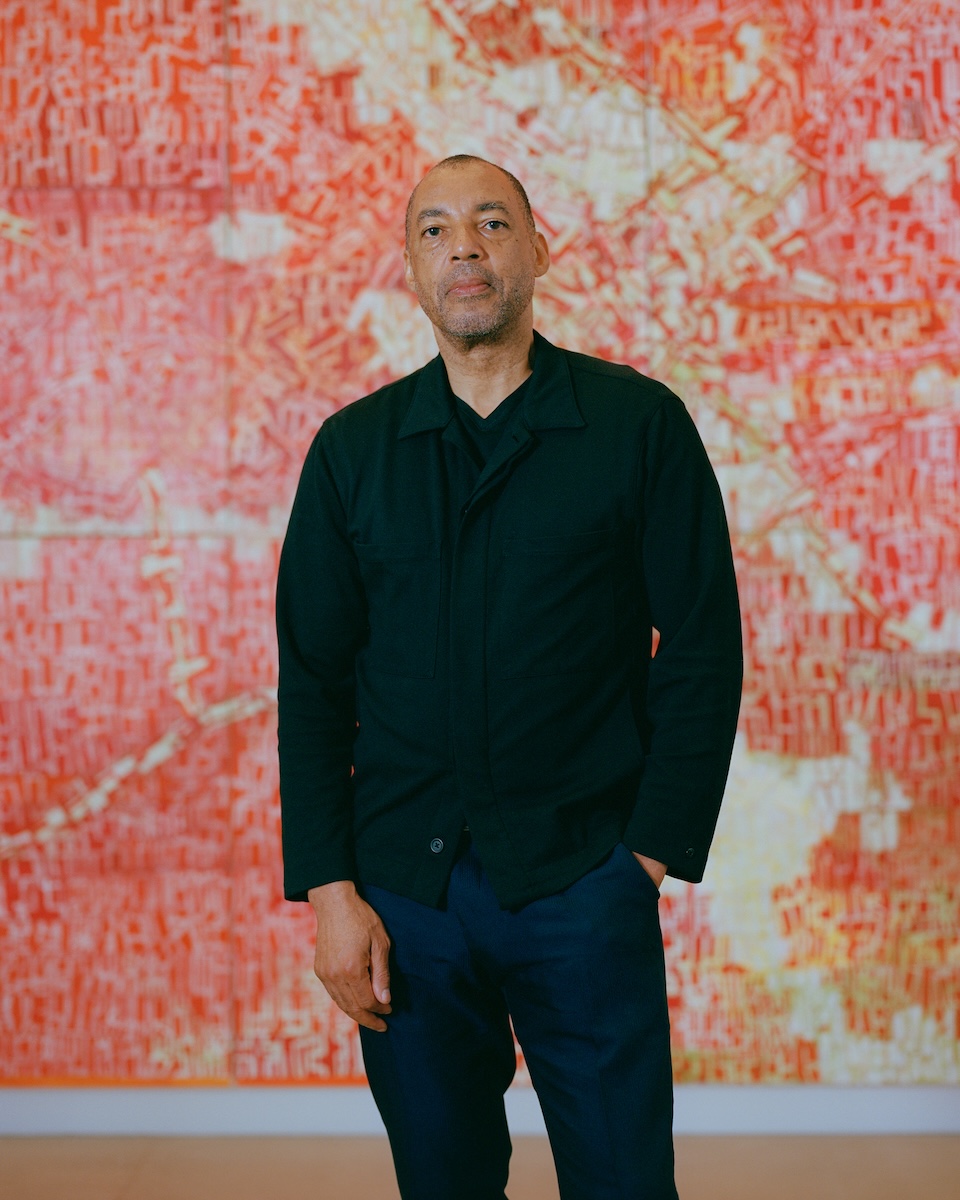
An Interview with Rick Lowe
By Carol Real
After more than 30 years with Project Row Houses, is there something in your methodology today that you never imagined at the beginning?
My career has been a series of surprises. First of all, I didn’t think I would become an artist. That wasn’t something I had my mind set on, or that I even knew was possible. My first semester, I was told that most athletes, I played basketball in college, took art classes because they were easy. I was completely surprised when I found that I liked it. I found it really interesting learning how to paint. At this point, I was learning traditional landscape painting.
While I enjoyed painting, I always believed from my early childhood that my life purpose was to do work that somehow connected with the struggle of people and issues of social or political justice. At a certain point, I started making paintings as a voice for those concerns. The paintings were very didactic and dealt with political and socioeconomic issues: police brutality, poverty, war, and things like that.
Then there was another turn, which was also unexpected. I thought I was doing great when I was making these paintings that dealt with those issues—until a young person visited my studio with their teacher. A friend of mine brought their class, and I had all these paintings about police brutality and poverty and all that. One student said they liked what they saw, but when they were leaving, the student said, “Your paintings and sculptures show what’s happening in our communities, but we don’t need that. We know what’s happening—we live with it every day. If you’re an artist and you’re creative, why can’t you create a solution?”
That question shifted my thinking. It made me reconsider the possibilities of art—how to explore making art that could be poetic and symbolic, but also have a practical element.
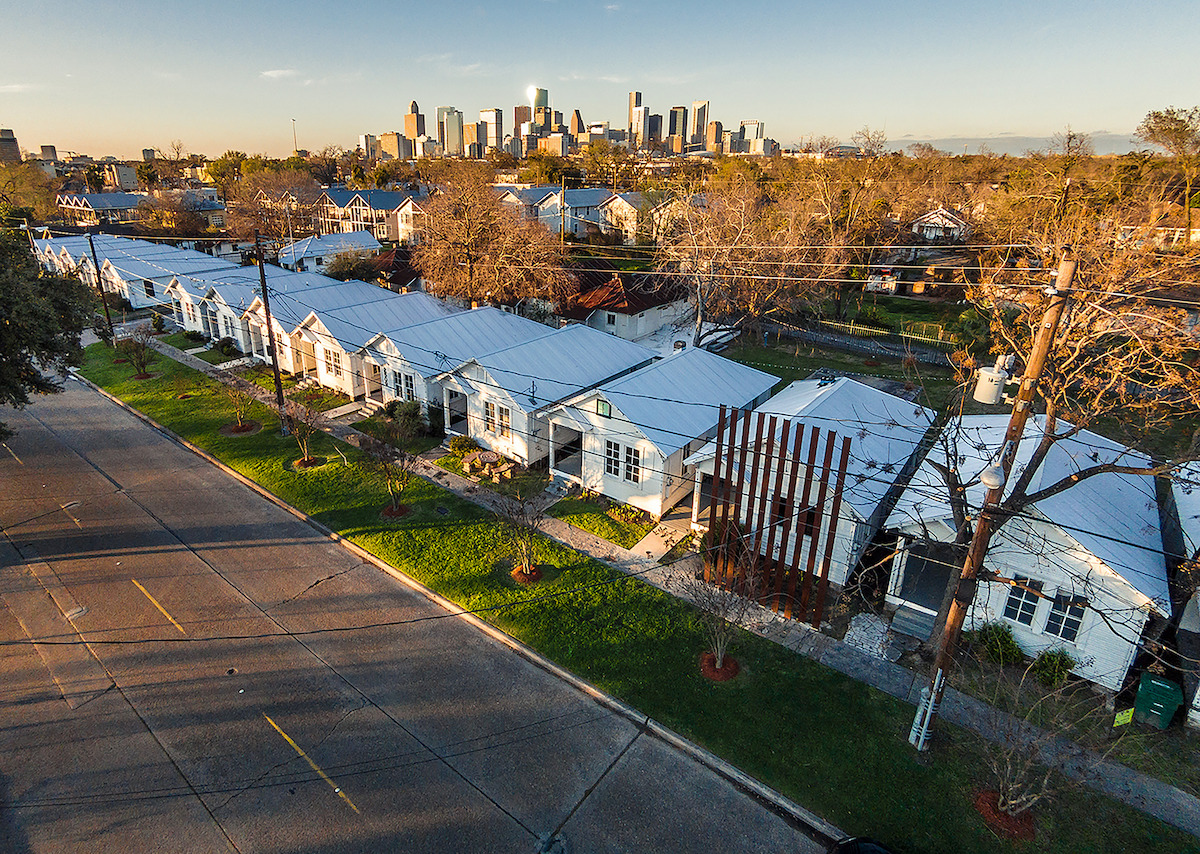
Then the next surprise that came along was social sculpture. After the student’s challenge, I shut down my studio and did a lot of reading about art while deeply involving myself with political activism. At some point, I picked up the book Joseph Beuys in America: Energy Plan for Western Man and was introduced to Beuys’ concept of social sculpture. I found it really interesting. He defined social sculpture as the way we shape and mold the world around us. And my thinking was: I can’t shape and mold the whole world—but maybe I could try to shape and mold a small piece of it. And that’s how Project Row Houses came about. That was a complete surprise. I had no intention, no idea, that I would be doing work that was conceptual in that way, and that it would have the kind of practical impact it’s had. I had no idea.
And then the next surprise is that now I’m back to painting. Abstract paintings, of all things. No way I could have predicted that. So it’s always been many unsuspecting shifts and turns in the way creativity has moved through me, through my career.
How do you recognize collective learning in a structure that’s so alive and constantly evolving?
I think one of the most valuable aspects of social sculpture is that it introduces the value of collective work, collective learning, and collective experiences. Another important aspect of Beuys’ concept of social sculpture is that “everyone is an artist.” I completely bought into the idea that to shape the world, or a community, or a neighborhood, everybody had to be an artist. We all had to dig into our own creativity to participate, which expanded the world to encompass people from all walks of life.
What I found interesting about that is how powerful it is when people from different backgrounds come together and work together—because it becomes a shared learning environment. When you’re mostly spending time with people in your usual circle, you have similar reference points, similar ways of seeing things. But what’s really essential for building community is getting challenged by someone who has different ideas about things. You work through those differences by coming together around shared values. I think the essence of social sculpture is when different ideas meet shared values.
For instance, as an artist, I know that generally I have different ideas and interests in housing than the typical real estate developer. For the real estate developer, housing is primarily an economic vehicle—something that generates money. While I understand and appreciate that as a motivating factor, I’m also interested in them hearing my ideas about housing as a space of meaning, of consequences, of social and psychological impacts, etc. To wrestle with those questions and figure out how they might coexist within or alongside that economic framework is fascinating. Those areas of overlap are where the shared learning can happen. To me, that’s been one of the most important parts of this practice: gaining a deep appreciation for the diversity of ideas and voices that can shape a work.
How do you take care of a living project so it doesn’t become mechanical or automatic over time?
I find parallels between my personal life and community-based projects. In both, there’s a struggle to fight off complacency, which generally leads to stagnation. It’s so easy to fall into routine, inertia sets in, things become repetitive and mundane. I think everyone is always fighting, all the time—in our lives, in our institutions, in our businesses, in everything. It’s normal.
But the one thing that’s interesting to me about social sculpture is that it encourages the idea of creativity coming from many walks of life and many perspectives. That’s what keeps things fresh and moving.
Creativity is tension between the known and unknown. So engaging diverse perspectives and lived experiences, can help move projects forward. The next step we take isn’t going to be based only on what we already know. It’s going to be a combination of what we know, the challenges we face, and how we move others along with us or how others move us along with them. If the project encourages creativity within a community, we never know where the next creative force will come from or what that force’s capacity to reenergize the work will be.
A diversity of ideas, how ideas feed off each other and push the evolution of ideads, is central to social sculpture—or social practice, or socially engaged art. This process of evolution, of developing ideas, can be very difficult and very frustrating. But it’s the best way to maintain vitality. I mean, that’s what democracy is about too, right? It’s the idea of having many voices—multiple voices—come together. People think, “Oh, democracy, great,” but democracy isn’t pretty. It’s not easy. It’s hard because within any group of people there are a million different perspectives, and sometimes, most of the time, those values aren’t shared or understood in the same way. Finding common ground requires finding a way to reconcile those differences and all of that work supports and shifts and changes the work.
You can’t be lazy in a democracy. You have to be active. And you can’t be lazy in an art project that intends to be vital. Because once you get lazy, it starts to stagnate, it stops moving, it becomes repetitive—and that’s when it loses its energy.
How do you navigate moments when your artistic vision clashes with the community’s immediate needs—like safety, money, or housing?
When artistic ideas clash with practical needs, it’s a very interesting challenge. My approach has always been to start with the practical—let the practical be. Because the practical usually has more limitations than creative or cultural solutions. As artists, we have many ways to wrestle with issues. But something like housing, for example, is pretty straightforward.
Instead of telling people who need housing, “Don’t worry about the housing, let’s invest our energy in a symbolic art gesture,” I always say: give in to the practical. Take what is known, what is needed, and ask: how do we layer this with deeper meaning and values that can expand the possibilities around housing?
It does put a lot of stress on the artist and on artistic vision—but I think it’s good in the end. It’s exactly what we need.
Early on with Project Row Houses we began to explore the possibility of building new houses, we formed a partnership with a professor at Rice University in Houston. He was teaching a class, and he got his students to help us explore about what kind of housing we could design to enhance the existing historic houses on the site.
I remember their first presentation. The designs were very creative and exploratory—they pushed ideas of design. Unfortunately, they had no relevance to the historic context of the place or to the houses that were already there.
I challenged them. I said, “These are interesting designs, but it’s easy to come up with something that looks creative. Real creativity is when you take the restrictions—the values of the people who live here—and use your design abilities to elevate those values. Take what’s already here and respond to it. Grow out of it. That’s much more powerful.”
Community always comes first. The practical needs come first. The most powerful moments occur when the creative process opens people’s eyes to things to actions or paths that can be more meaningful than they imagined.
If someone doesn’t have a house, their immediate concern is having a home. That’s their priority. They’re not thinking beyond that. But if you engage them in a project that frames housing not just as a roof over their head, but as something that enriches their family, connects them to their extended community—then suddenly, they see their need in a larger context. It becomes a richer experience.
It’s about starting with the practical and expanding the possibilities.
Project Row Houses began with the idea of the shotgun house and disinvestment. That gave it a very concrete, physical dimension. Renovating those houses was a very practical thing to do—and that was fine. But as an artist, that alone wasn’t enough.
So I started looking for the historical relevance. I looked for ways to foster creativity within that structure—to bring people together from inside and outside the community. And from that very practical beginning, all kinds of creative and enlightening things came. Much more than if we had simply imposed some dreamy artistic idea on people who were focused on meeting immediate needs.
How do you know when it’s time to step away from a project? What signals do you pick up in yourself—or in others—that tell you your presence might no longer be needed or could even get in the way?
I don’t think projects are any different than painting. If I think about painting—people often ask, “When do you know a painting is finished?”—I don’t think there are absolute lines or fixed rules. I think it’s more intuitive. It’s about a feeling.
For painting, I always tell people: it’s when I feel like I don’t have anything else to offer it. I look at it and think, “Maybe I should put some yellow here.” Then I sit with it and go, “Nah, it doesn’t need that.” That’s when I know. And I say, “Okay, it’s finished.”
With community projects, I think there are many signs that it’s time to step away—and they can come in different forms.
There have been projects I’ve worked on that I just couldn’t get off the ground. There was some kind of conflict—either with the host who brought me in, or with a part of the community. You can sense when there’s no synergy, when something isn’t flowing. And if the synergy’s not moving, then something’s not right.
But that doesn’t always mean the project itself is wrong. Sometimes it just means you’re not right for it. Conceptually, the project might be fine—but maybe you’re not the person who should carry it forward. There have been times where I ended up bringing someone else in to move it forward. And it worked just fine. My energy just wasn’t right for it anymore.
There are also times when you may not feel like it’s time to leave, but other people do. And you can fight to stay—but what value does that really bring?
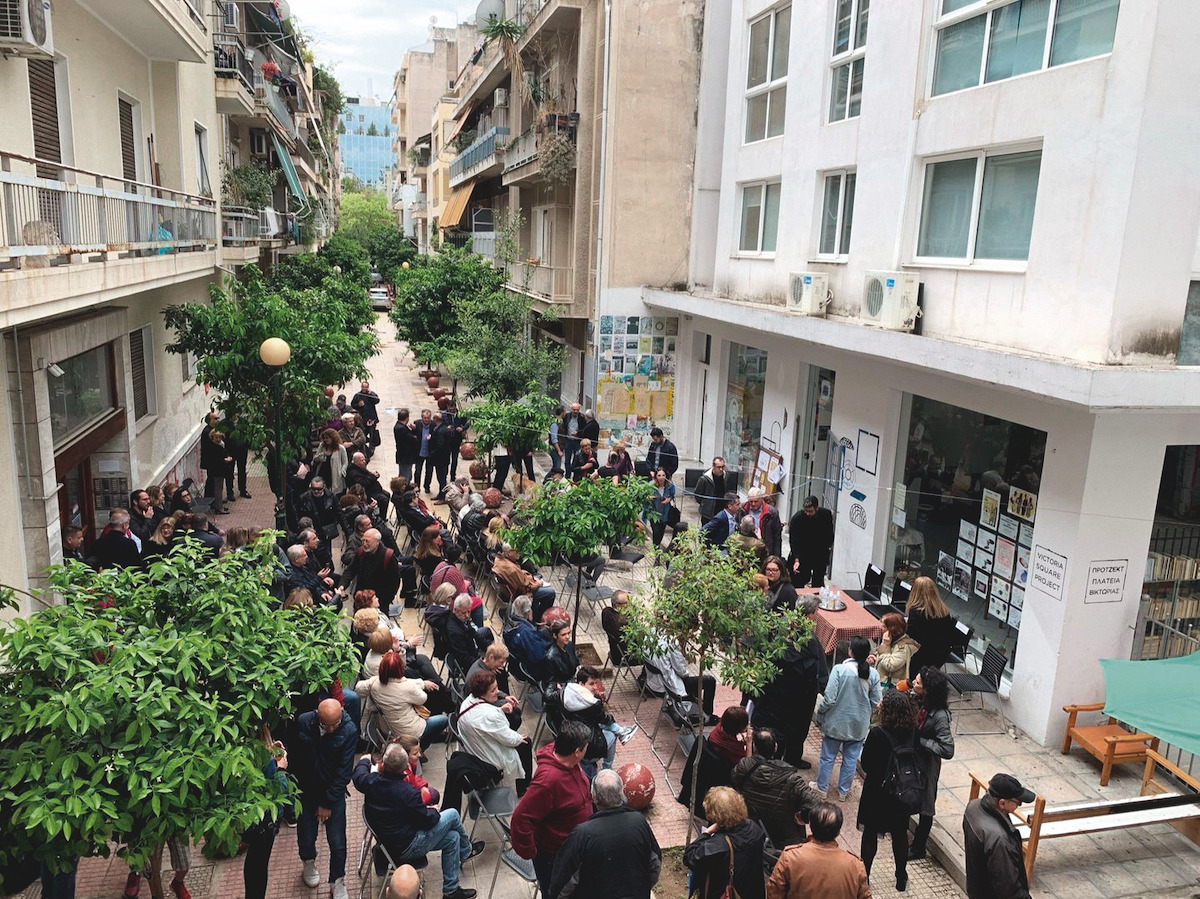
That’s happened to me, too. One example is the project in Athens, Greece. It started as a six-month project, part of Documenta 14—but it went on for five years. And it was still going strong, but because I had to reduce the time I was spending there, all the pressure to hold it together became the responsibility of my Greek collaborators. Some unresolvable conflicts arose amongst the leadership team, I knew it was time for me to step away, and the project was sunset. I was devastated because I felt like I had quit on the community. But from a distance and as a foreigner, I didn’t feel I could effectively support the project. This was all very unfortunate, because the project itself was good and had so much more to offer. But, it had reached an end. People will fight to stay in things when they shouldn’t. But it all depends on the individual.
I always try to be as generous as possible toward the community I work with, and to follow what I believe will contribute to making life better for them. Because ultimately, a community-based project—from my perspective—is best when it’s done with the community, for the community, and all about the community. It’s not mine. So if I’m struggling to figure out how it needs to work for me, then I’m not really following the code of ethics I believe in.
What are the toughest limits you face today, now that there’s more visibility—but also more scrutiny and outside expectations?
I think the toughest limit now, honestly, is getting older. I just don’t have the same energy. And it takes a lot of energy—and a lot of passion—to move community projects forward. It’s a different kind of energy than what’s needed to make paintings or objects. With community work, you’re dealing with so many other energies feeding back into you. And that’s tough. Really tough.
I also think that having more recognition creates another challenge, because it builds expectations. And for me, the most important thing in community projects—especially at the beginning—is managing expectations. I always try to manage the expectations of the people I’m working with. I’d always rather have people be pleasantly surprised by positive results, as opposed to terribly disappointed by a lack of results. I never want to raise people’s hopes too high.
Most of the time, the work I’m doing touches people’s lives—it’s about their communities and you have to be realistic about that. I don’t like the idea of people thinking artistic endeavors are some kind of magical potion—that you just show up, bring the art, and everything transforms. I don’t believe in that.
I mean, I do believe that magic happens sometimes. But not always. Most of the time, it’s about struggle. It’s not any different from life. Life has magical moments—but also disappointment, difficulty, and grit. I try not to separate the two.
That can be misleading—just like social media, where you only see people at their best, in their best environments, all polished. And you think that’s their life. But the truth is, there’s a whole other side that’s tough, gritty, hard, disappointing.
That’s the place I try to start from: understanding that it’s going to be hard. It’s going to be dirty and disappointing. But we’re going to bring our creativity together. We’re going to think hard, work hard, and do our damnedest to make something incredible for the folks we’re trying to serve.
And then, when those disappointing moments come—and they will—people understand that’s part of the process. Some may drop out because of it. But others dig deeper into the well of creativity and try to push through it, to get to the success they hoped for.
It’s not simple. It’s not easy. And it takes a lot of energy and that’s where my limitations are now. But the great thing about collaboration is that you’re working with people, and you get energy from different places. When one person’s energy starts to fade, someone else comes in with theirs—and keeps it going.
Can you share a moment when a project completely failed? What kind of failure was it—one of listening, scale, or idealism?
Success is interesting. It gives you confidence—that sense that you can move mountains. And sometimes that’s a good starting point, but it can also skew your sense of what’s possible.
I’ll give an example—not of a specific project, but of a moment that speaks to human nature and how things can go wrong. I was once in San Francisco visiting friends, and they told me there was a small local conference on socially engaged art. They said, “You should come—people would be excited to see you.” So I went.
When I arrived, I saw many familiar faces. It felt great. Then someone said, “We’re about to break into groups. Would you mind joining one of them?” I said, “Of course.” They assigned me to a group of about 12 or 15 people sitting around a table.
There was a woman handing out papers with a long list of things happening in her community. We went around introducing ourselves. When it was her turn, she didn’t just introduce herself. She launched into all these issues and concerns.
People started pushing back on her—trying to silence her. And I thought, “No, you can’t do that. That’s bad practice. You have to listen.” I interrupted and said, “Let her speak.” And she was shocked. She looked at me and said, “Nobody’s ever done that before. Nobody’s ever said I should be heard.”
She continued talking—and she talked and talked. People were getting restless. They kept trying to help her wrap it up. So I tried to guide her back to the paper she’d handed out. And then, suddenly, she slammed her papers down on the table and said, “I knew it. Nobody wants to hear what I have to say. Nobody.” She got up, gathered her things, and walked away.
I felt terrible. I thought, “No, no, we do want to hear you—we’re just trying to move the conversation along.” But it was too late.
She walked toward the coat rack. I hesitated. I thought: I know this kind of work. I know community engagement. I should go talk to her, let her know we care. So I followed her. And as I approached, before I could say a word, she screamed at me: “Get away from me! I have high blood pressure! I have heart attacks!”
She was completely hysterical. I backed away, stunned.
And here’s what I realized: everyone else at the table knew her already. They knew exactly how this was going to go. But I was the outsider. And because of my own confidence—because of past successes—I thought I understood the situation. I didn’t.
That moment taught me something crucial: when you lack proximity to people, you miss the signals. You don’t see the whole picture. And even experience—especially experience—can be a liability if it makes you overconfident.
Most failures in this kind of work come down to communication—either things not said, or things misunderstood. Sometimes it’s fear, or a lack of honesty. But mostly, it’s about not really knowing the people you’re engaging with.
You once used dominoes to map a neighborhood. Now your paintings feel like abstract cartographies. Do they still speak without words?
Dominoes have played a big role in both sides of my practice—community engagement and painting.
In my community work, dominoes come from where I grew up. They’re a social tool. They create a relaxed environment where communication is clearer—and often more honest. You ask someone a question at the domino table, you get the real answer. If you ask that same question in a formal community meeting, people might tell you what they think you want to hear.
Dominoes allowed me to create those more open spaces—where truth could come through.
They also work as a metaphor. In community practice, every move you make affects others. Just like a domino game. One shift can create a chain reaction. If you set it up just right, the ripple effect can shape the whole project. That’s how I think about the work: one move, one connection at a time.
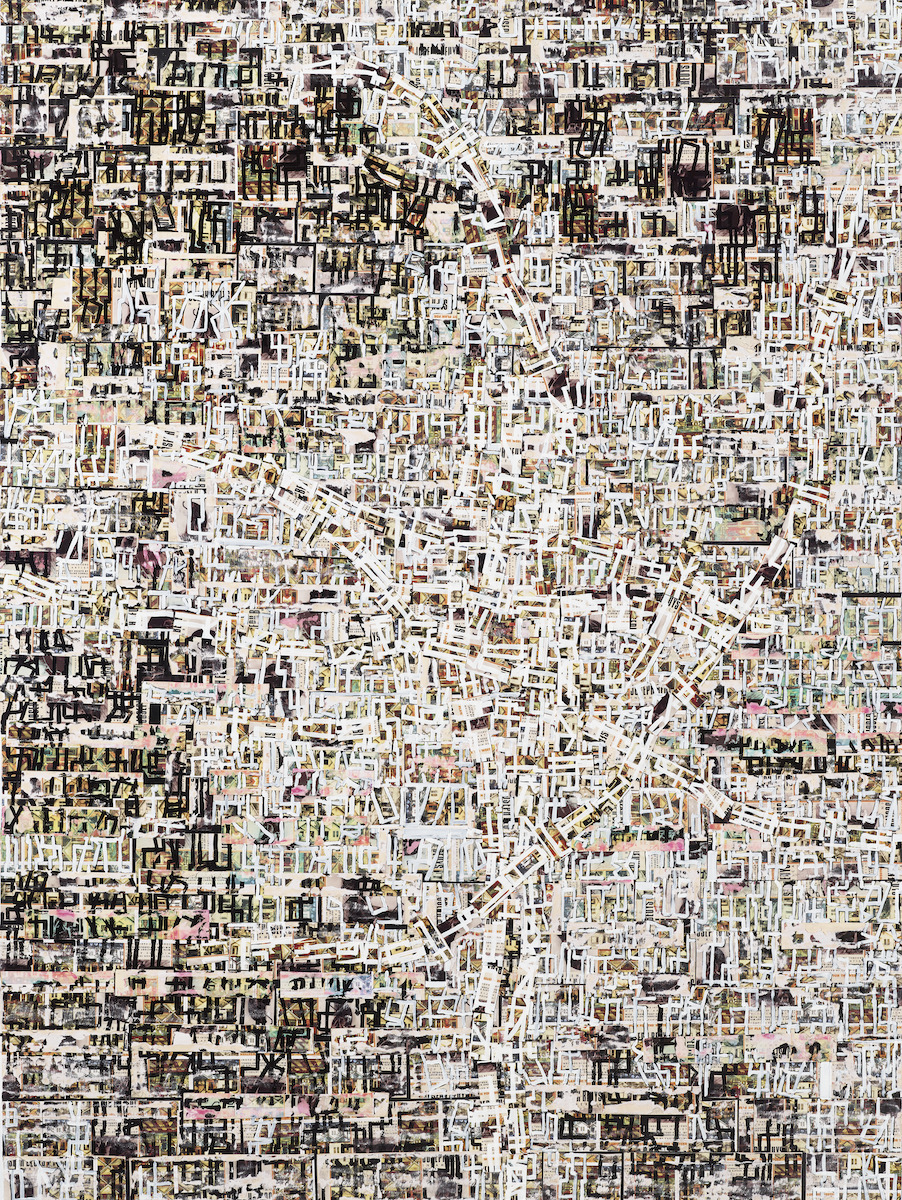
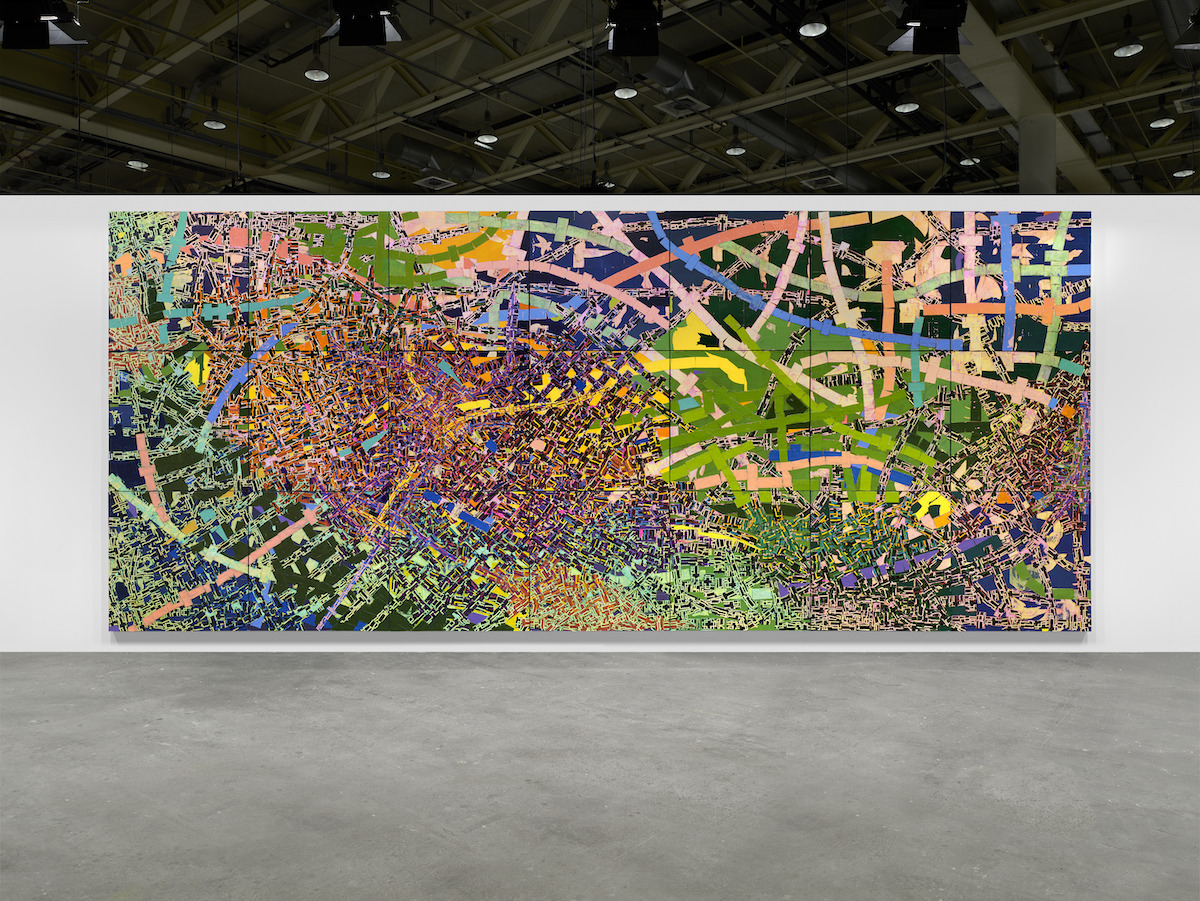
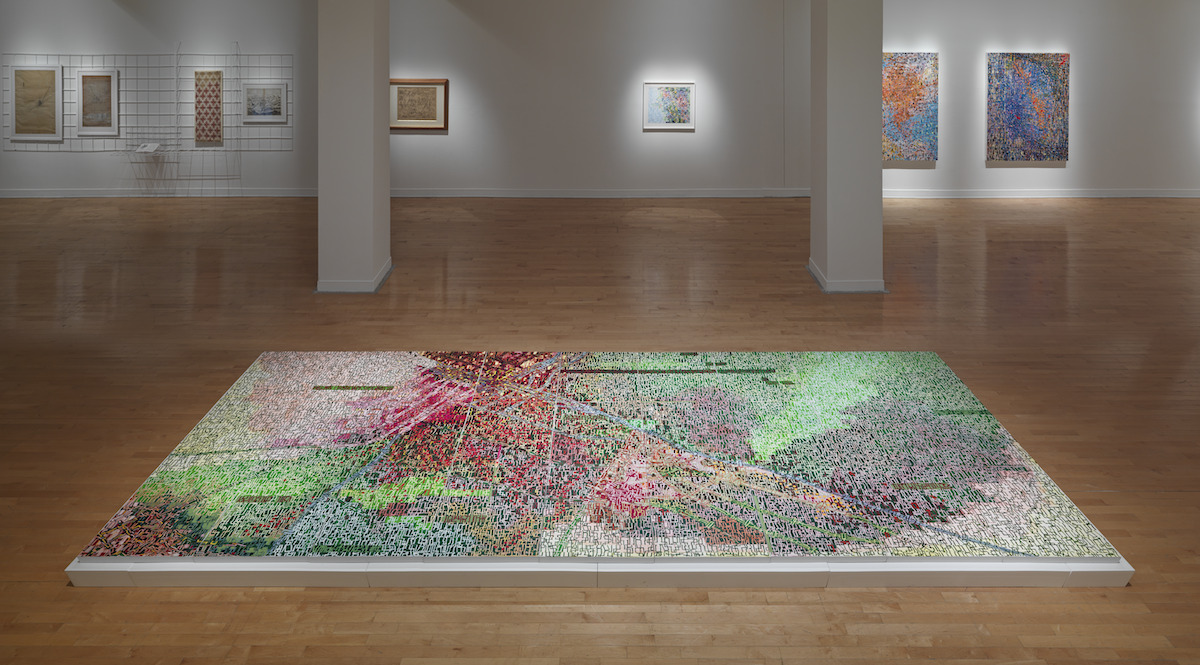
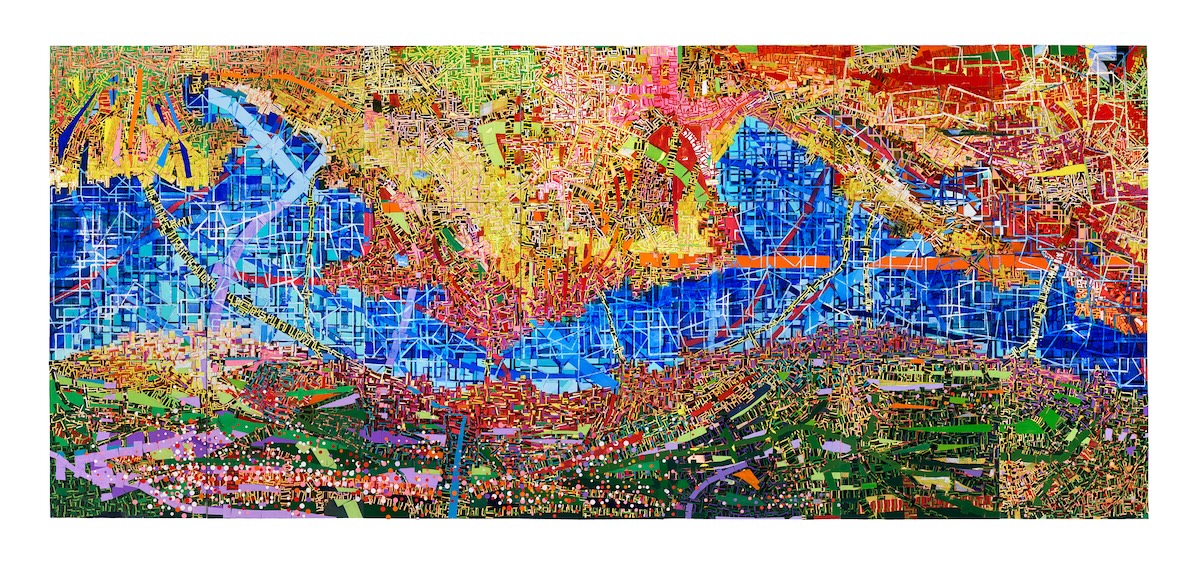
In painting, it’s different. Dominoes are no longer a participatory tool—they’re reflective. The forms become symbols of community movement, connection, tension. They invite contemplation.
Even people who’ve never played dominoes can intuitively get the meaning of the paintings. There’s movement, mystery, rhythm. Color carries you through. And beneath it all, there’s the question: how do the parts of a place fit together? Where’s the friction? Where’s the flow?
It becomes a visual language—a map without words and a game to ponder.
When did you realize that play—not pedagogy—might be the best way to connect? What did dominoes teach you that no institution ever could?
Working in low-income communities—and really, in most communities—I learned early on that the key is to keep things simple. Most people haven’t studied art theory or community development. Even “educated/professionals” are disinterested when you start using abstract language. They tune out. They disengage.
Games like dominoes made everything click for me. They grounded the work. They showed me that play creates access—access to honesty, to connection, to collaboration.
We should strive for simplicity. Not because things aren’t complex—they are. But if you begin from a place of simplicity, you give yourself room to let complexity unfold naturally.
I had a mentor who once said something I always remember. We were reading philosophy—Aristotle, and a little bit of Immanuel Kant. He said: “Aristotle strived for clarity, and sometimes achieved it. Kant strived for obscurity—and always achieved it.”
That stuck with me. I try to be the Aristotle in the room in terms of striving for simplicity.
Let things get complex—but don’t start there. If I’m trying to help a single mother, I don’t start with a lecture on the history and theory of single parenting. I start by asking: does she have a house? That’s step one. From there, it gets more complicated—income, childcare, mental health, everything else. But we begin simply.
That’s honest. That’s real. And dominoes taught me that—by creating an atmosphere where people can just be themselves, and talk without pressure. That’s where real work begins.
Your abstract paintings seem to translate invisible patterns of coexistence and displacement. Would you say they’re a way of archiving what’s disappearing?
I once read a line—don’t remember where—that stuck with me. It goes something like:
“The newly paved road rarely pays homage to the dusty gravel underneath it.”
We tend to forget what we’ve moved beyond. We want to erase the past once it becomes inconvenient or outgrown.
For me, painting is a way of pushing against that. It’s my way of saying those dusty roads matter. There’s something in them that lingers—shapes us, stays with us—even if we’re no longer walking them.
That’s why my paintings—while I hope they’re beautiful—are also gritty, torn, unresolved. Because that’s what those places feel like. That’s what those histories feel like. We’re always caught in a state of becoming and disappearing at the same time. Everything we do holds both.
Some of the paintings are direct references. They archive specific places or moments. Others are more intuitive, drawn from memory and emotion. But in all of them, there’s a recognition of fragility. They say: this mattered. Even if it’s gone now, it mattered.
From Alabama to Houston to Athens—what sensory elements (smells, sounds, rhythms) have changed how you move through the world, and maybe how you make art?
The one thing that’s stayed constant—and I’ve come to just accept it—is my sensibility. I’m someone who seeks calm. I don’t like frantic energy. I like situations where there’s urgency, sure—but where the urgency is steady, grounded. Not chaotic.
Growing up in rural Alabama shaped that. My first visit to Athens, Greece helped me understand this. I understood quickly why I felt so at home in Athens. It combines two things I love: the warmth and ease of Southern culture, and the intellectual richness you get in more cosmopolitan places. Athens felt like New York if it were in Mississippi.
You can talk to anyone there. Sit at a café, take your time. That reminded me of the Southern tradition of sitting, having porch conversations. And at the same time, you’re surrounded by layers of history, philosophy, and creativity.
What really guides me—wherever I go—is the search for calm. I walk. That’s my practice. I walk to feel the city, the people, the pace. Whether it’s under a tree in Alabama or walking from Chelsea to the Guggenheim, that’s how I connect.
It allows for intimacy—with place, with time, with myself. And that, I believe, is essential to being a community-engaged artist. You have to be vulnerable. You have to show that you don’t know everything—that you’re open to being shaped, too.
There’s power in that. When people see your vulnerability, it invites them to step in. It gives them strength. Especially when they trust your intentions. That kind of shared strength—that’s what fuels a project. That’s what keeps it alive.
When you’re alone in front of a painting—without community, without cause, without history—what remains of you? What shows up when social commitment steps back?
What I’ve learned is that I’m pretty much the same person and behave the same way in the studio as I do on the community level. One of the things people who work with me in a community context often say is that I don’t have firm ideas. I’ll change quickly, go from one thing to the next—I’ll switch. I think people call this processing out loud. I’m not good at thinking things out to an end point. I’m generally processing things in the moment. So new information or influences are easily accommodated. And it’s the same in the studio. When I’m working with color, for example, it’s constantly in motion.
I attribute that to my understanding—or maybe just my belief—that I’m not an expert in anything. I’m always trying things, trying to learn, trying to understand, but I’m not certain about anything. That mindset makes me vulnerable in a community context. I might come in thinking, “This is what we should do,” and then someone challenges it, and I’ll say, “Okay, let’s reconsider.” I approach painting the same way. I might start thinking, “This is going to be a red painting,” and then as I go along, I realize it’s not—it’s a blue painting, or something else entirely.
Like I said, even when I’m in public, I don’t hold anything back. I just have to be who I am, for better or worse. I try to be kind of calculating in my thoughts and decisions—but it never works. It always turns out better when I just let it be who I am.
Is there a conversation you haven’t had yet, but would like to before you die? Who would it be with, and what would it be about?
I’d like to talk to Neil deGrasse Tyson. He’s an astrophysicist, writer, and science communicator. He’s one of those people who seems confident in knowing. I’d like to be in his presence—he’s obviously super smart in many different ways and so knowledgeable.
But I’m at a stage where I question knowledge. I question how it’s used and how it’s manipulated. I feel stuck in this place where there’s so much information out there, so much knowledge—but where does it all lead? As the great musician Curtis Mayfield sang in the song Freddie’s Dead in the 1970s: “We can deal with rockets and dreams, but reality—what does it mean?” Neil deGrasse seems to have interesting takes on almost everything, so he’s who I want to talk to about that.
Your work moves between the visible and the invisible, the practical and the spiritual. Do you have a secret belief, a ritual, or a private thought you’ve never shared, but that guides your practice?
From the community work I’ve been involved in, it’s based on this belief that as a species, we don’t value or utilize the infinite amount of creativity we have. We tend to allocate creativity to artists, or to people in industries like design or economics—but everyday people often don’t recognize the value of their own capacity to participate creatively in shaping the communities and the world they want to live in. That belief guides that part of my practice.
From the studio side, it’s still connected. I understand there are people who will see my paintings who have no proximity at all to the community work. But through the paintings, they may have a reason to get to know me and think a bit about the community work I’ve been engaged in over the years, and hopefully expand, at least on a conscious level, their awareness of what’s happening around them.
In your community projects, there’s always a will to repair. But have you ever felt that something you did with good intentions ended up hurting someone? How do you deal with harm that can’t be undone?
The question deals with the idea of intentions versus results. If you have the intention of doing something, but the result isn’t what you intended—and it could be harmful—that’s a real challenge. I don’t have any direct examples of that, but I’d say most of it has to do with my own disappointment in the outcomes, rather than others feeling harmed.
First of all, I work very slowly, and that helps. It minimizes the kinds of challenges that could result in harm. That slow pace gives time for things to unfold, so you can catch it if something starts going in a hurtful direction.
Also, in general, the projects I work on are structured so that the responsibility of what the project becomes is shared with the people I’m working with. I’m not forcing anything on anyone. So if things end up going in a direction we hadn’t hoped for, it’s not solely my responsibility—it’s the responsibility of the entire group working on it.
Now, if I were to get more philosophical about it, from the standpoint of my involvement, there’s a bigger dynamic that sometimes happens. People often say this about artists: when they move into declining or disinvested neighborhoods, their creativity generates interest from real estate developers or property owners, and eventually the artists—and the people already living there—end up displaced.
When I look back on my efforts with Project Row Houses, that kind of argument could be made on some level. But it’s not wholly true, because the situation is much more complicated than just saying, “We started this project and it rang the bell for other people.” We were allowed to move it to a certain point, and then investors started coming in—not necessarily to benefit the people who had been living there.
The shift of new development for high-income folks displaced some residents and caused a decline in affordable housing opportunities. There is an argument that can be made that this was detrimental in some way, but it’s not the whole story. There were too many other factors at play. Project Row Houses was just one small part of a much larger process.
One of the things I’m extremely cautious about is the possibility of doing something that could be harmful to others. That’s one of the reasons I try not to go into places with an agenda. If I come in with my own idea of what I want to do, it risks overriding what the community might need or want. So I try to enter with an idea that can be developed collectively. My ideas are generally so broad and conceptual, each person who engages helps shape the idea—even on a conceptual level—and continues to shape it as it develops. If there’s no interest in the broad general concept, there’s no project. Of course, sometimes the project ideas are not supported because it’s the wrong location, the wrong time, the wrong [fit]. That’s why I go into projects with an understanding that it may take a long time to find the right place, people, timing, etc.
Have you ever sensed resentment from the community toward you as a “figure of power”?
Yes. In the very early stages of Project Row Houses, there was a person—he was the same age as me, we were all in our early thirties—and I went in the direction of creating Project Row Houses as an artist, while he went in the direction of becoming a politician.
I supported his opponent and I think that may have had something to do with him having an issue with me. For six or seven years from the beginning of Project Row Houses, I would always hear people say that he spoke very negatively about me and about the project, and I never quite understood why.
The community leaders I worked with to get support for the project would tell me, “Don’t worry about that, that’s just his personal issue.” And then later, I found out what it was. He told me a story—I’m not sure I remember it exactly—but it went something like this:
There was a chicken and a pig. The chicken said, “Let’s have breakfast.” And the pig said, “Sure, what are we going to have?” The chicken said, “How about bacon and eggs?” And the pig said, “Wait a minute. You just have to lay an egg and keep going. I have to give a part of my body for this.”
His point was that his family had been in the community for generations, so he was like the pig—he had real stakes in it. And I was like the chicken, just coming into the community to lay an egg, and if it worked, I could move on, but he would lose something of himself. He was very critical of that.
He told me that story because he had finally come to understand and accept the fact that the work we were doing was valuable. And later, he became one of the biggest supporters of the project.
There are often people on the sidelines who, for their own reasons, hold onto resentment. Many times, those people won’t come forward to say what it is they object to, so you can’t work through it—it just sits there, until eventually they engage or they don’t.
The symbolic power of the artist in certain communities can become a form of authority. Have you ever had to confront your own figure of power? What part of your ego are you afraid to feed?
My approach to this is that when you go into a community context and do community work, you have to check your ego at the door. This is just community engagement at the most basic level but just because it’s basic does not make it easy. In fact, it’s incredibly difficult. People who are smart, think of themselves as progressive with good intentions, often feel a kind of righteousness about their abilities.Tthey approach the work with an authoritative presence—mostly without even knowing it. Because I’m aware of this, I purposely check my ego at the door.
Oftentimes, when communities want to do things that I know are not the right thing to do, I’ll push in a critical or antagonistic way to generate critical thinking—but never to enforce or take authority in the situation. I don’t try to impose. I walk away. And there are many times when I was right, and there are times when I was wrong.
But there’s one ego part—and this just came up recently. I struggle with it, because I haven’t quite settled on a particular feeling about it. When you’re working with large collaborative groups, some people are very close in the collaboration and some are not as close. But as the initiator or the lead artist, there are opportunities that come up to talk about the project. I’ve been accused a couple of times of not mentioning other collaborators in certain situations.
I generally think it’s just being caught in the moment. You’re trying to express something, and it’s hard to go down the list. That’s one of the reasons I was never very good at fundraisers—when you have to get up and thank everybody. I don’t know the list, so it’s hard for me to do.
My dear friend and Greek collaborator Maria Papadimitriou on the Victoria Square Project in Athens—she just called this to my attention yesterday. It had been bugging her for some time. I was in Venice, doing a talk, and I mentioned Victoria Square Project and talked about it a little. She said she was in the audience, and I never mentioned her as the co-collaborator. I don’t remember that so well, but who knows? Of course, I apologized. She was kind of hurt by that, I guess. So maybe my ego stepped on her. I try my best not to do this.
Sometimes, institutional attention can dilute the deeper content of a work. Have you ever felt that certain institutions have used your work without truly understanding it?
Yes, but most of my projects have come about in three ways. One is being invited by art institutions. Then there are community institutions, and finally, self-initiated projects. With self-initiated projects, you get to lay the ground rules—that’s what happened with Project Row Houses.
Community institution–initiated projects have their own challenges. They don’t always have a clear idea of what artists do or bring to the table, but they know it’s something they want. They’re more willing to allow you the freedom to bring your value forward.
Art institutions are the tough ones. They’re generally focused on the idea of artistic excellence, and they have strong notions about what is valuable and what is not. And because it’s their arena, they’re not shy about asserting that. They can put a lot of pressure on you.
I’ll give an example from a long time ago. A lot has changed since the mid-1990s when I worked on a project for the Museum of Contemporary Art in LA. I was invited by two curators who have become great friends of mine. It was one of the earliest museum social practice exhibitions I’m aware of. I found it challenging because I was young and didn’t know how to assert myself as an artist. I didn’t have the experience to speak up about my desires, which were more about the community than the museum.
The challenge with the project at MOCA was that it was trying to be both a museum exhibition and a community-based project. At that time, the relationship between a community project and a museum was still unclear. We hadn’t answered the question of how or to what degree a museum initiated project can manifest in the community. For example, how we used the budget to support both aspects of the project was an unresolved question. There is a lot more clarity nowadays, but back then, the exhibition and the community components were basically separate in the case of my work, which was tough for me. Most of the resources for my involvement went to the exhibition. If I were doing that now, I would’ve pushed for more of those resources to go into the community component.
What part of yourself never shows up in public? What Rick Lowe do most people never get to see?
One of the things I often find interesting is that people are sometimes surprised by how open I am when I talk about things, because I just feel like that’s who I am. I’ll say things that maybe aren’t quite the right way, but I say them. And I’m not afraid to apologize either—if I say something that’s offensive or doesn’t come off right, and I understand that, I’ll apologize for it.
I don’t hold anything back. I put it all out there. When I’m working, especially, I put my vulnerabilities out there. I let people know that I’m just a guy trying to figure out how to help within a community context.
Do you have personal rituals when arriving in a new community? What do you observe, what do you stay quiet about, what do you repeat?
My ritual is walking. That’s it.
When I’m invited somewhere, people often want to show me around—and I’ll do that, of course. But the moment I can, I go off on my own and just walk. That’s always been my way. I walk without knowing much, without an agenda. Just walk.
The first time I went to Athens was a good example. I was invited to speak at an event, and I was excited—I’d never been there before. But on the way from the airport to the hotel, I kept wondering, “Where is the city?” We were in the southern part, near the beach, and I felt disoriented. I wanted to understand where I really was.
So I took a map, found the center of Athens, and started walking. It was late June, hot, maybe four and a half hours of walking. Along highways, through neighborhoods, all the way to the sea, and back. A full day of walking. But that’s how I understood the place.
Same thing when I got to New York—just yesterday. I flew in early and walked from my hotel in Chelsea up to the Guggenheim, stopping along the way. And then I walked all the way back. That’s just what I do.
If it’s a place I’ve never been, walking helps me explore. If it’s a place I know, it helps me notice what’s changed—how people move, how architecture shifts, how space feels different. That’s what matters to me.
When you walk through a place for a long time, your body begins to understand things that words can’t reach. What have you learned through walking that you never could have grasped otherwise? And what does physical exhaustion teach you about your relationship to the world?
I think walking, for me, allows me to see the beauty of things—ordinary things we might never think about. It also reveals ugly things we might overlook. But just being able to walk, and really look, even without going far—it depends on how deeply you look.
Just being in the world, in public space, is powerful. We don’t do it enough. I mean, I don’t often look at the palm of my hand, but if I really looked, I could see so much there. And it’s the same when you go out into the world—into cities, rural areas—it’s just amazing.
That kind of walking satisfies me more than anything. I love museums, I love art spaces, and I get a lot from them—thinking about what artists are doing and how they’re interpreting things. But in terms of being fulfilled, being nurtured—walking in the streets, in the woods, wherever—that’s what really feeds me.
In a world obsessed with speed, would you describe yourself as slow? What value does slowness hold for an artist engaged with the rhythms of the social?
I think it’s just about taking time to absorb things and allowing yourself not to move through too fast. Different people have different ways of doing things, obviously, but for me—I’m a Southerner. That’s part of who I am. And in the South, I love that people move just a little slower. You can sit and talk, say hi to somebody, and you’re not rushing off to get to the next person. You stop, you say, “Hi, how are you doing?” and you can have a conversation. It’s a nicer way of being—a nicer rhythm, for me.
I remember a situation once with the scholar bell hooks. Somehow, I was contacted by someone who knew I was friends with bell because they wanted her to write something for Artforum. They wanted it quickly and they asked me to reach out to her. So I called her and said, “bell, Artforum wants you to write something.” And she goes, “Okay, tell them to send me a letter.” I said, “What do you mean?” She said, “Mail me a letter. If it doesn’t get here in time, they’ll just have to get somebody else.”
She really valued slowness in her later years. Letting things arrive when they’re supposed to, instead of chasing after them.
Sometimes you just have to let it happen when it happens. You’re rushing to catch a train in New York, and you make it—but then that train gets stuck, and the one that came later moves ahead. Or you’re rushing to catch a flight, and it gets delayed, while the one an hour later takes off on time. Sometimes, you just have to let it happen.
Do you remember a specific project where you changed someone’s life—or someone changed yours?
There is one person who comes to mind that I’m in awe of. Her name is Assata Richards. She was a single mother when she came to Project Row Houses. She had a young son, and she was angry, disappointed, and just struggling. But after being in the Project Row Houses young mothers’ residency for two years, being treated like an artist, being part of a creative community—she transformed.
She went on to get her PhD in sociology at Penn State University and later taught at the University of Pittsburgh. Eventually, she came back to Houston. I introduced her to the mayor, and she was appointed as a housing commissioner for the city. She became chairperson of that board.
Now she’s a powerful consultant, working on community issues. She’s brilliant. And the thing is—she became my mentor.
I mentored her for years. But now, when I hit situations I don’t know how to navigate, I call her. I ask for her advice. And she helps me out.
And thinking ahead… What would you like to keep working in your practice after you’re gone? How do you imagine a living legacy—not a monument, but a way of doing that others can carry forward?
Ideally, the way for something to move forward is through leadership—people who’ve worked with you, who understand the why of what you’ve done, not just the what.
I don’t know if I’ve been great at that. I’ve had success in a lot of ways, but not necessarily in creating continuity. I never set out to train someone to do what I do, or to keep a specific project going after me.
What I do have, though, is a long list of people. People I’ve worked with who’ve taken something from the experience and carried it into their own practice. They’ve made it their own. And maybe that’s the point.
This question is actually making me reflect. I’ve never really thought about legacy in a structured way. My path has been organic. Sometimes messy. And I’ve seen those “best practices” guides or “how-to” books—I don’t think I could write one. I’m not sure I even follow best practices myself.
What I believe in is that people will find their own best practices. They’ll build their own ways of doing. That, to me, is closer to art. Because in art, the goal isn’t to follow rules—it’s to challenge them. To prove something possible that others thought wasn’t.
Maybe that’s the legacy. Not a process, not a model—but a belief that you can create your own.
If tomorrow you lost your ability to speak and could only communicate through a painting, what would you make appear in it? Would it be a map, a gesture, an absence?
It would depend on who I’m speaking to—what I’m trying to say, or what I’m charged with expressing. If it’s a painting meant to convey how I feel about life in a particular moment, then I think… color. Color would be the clearest way I’d want to communicate, because I’d want to express how I’m feeling. And for me, that comes through color.
After giving so much, how do you recover? How do you take care of your spirit without romanticizing sacrifice?
I’m not too good at that, honestly. I like working. How do I recover from work? Work more. It’s probably not a good strategy—or a good plan.
For instance, for all practical purposes, I probably shouldn’t be at the studio today. Yesterday, all the paintings and works on paper were photographed, so it feels like something’s been completed. That should be a moment to pause, right?
But here I am. I came in, started doodling around, just seeing what’s next.
All images courtesy of the artist and Gagosian.
Edited by Kristen Evangelista.
This interview was conducted in June 2025 and has been condensed and edited for clarity.