In Y.Z. Kami’s paintings, the human face becomes a landscape of silence. Whether portrayed with eyes open or closed, each figure seems suspended between the visible and the invisible, the temporal and the eternal. From his monumental portraits to the meditative geometries of the Dome and Endless Prayers series, Kami’s work moves with rare coherence between intimacy and transcendence, inviting the viewer to inhabit a space of contemplation rather than observation.
Born in Tehran and educated in Paris, Kami’s artistic language emerges from a confluence of traditions. His deep engagement with Persian poetry, Western philosophy, and sacred texts from diverse religions forms a visual theology of sorts—one that does not illustrate belief, but reflects on the condition of being. Over decades, he has developed a pictorial practice that dissolves the boundaries between form and spirit, surface and depth, matter and light.
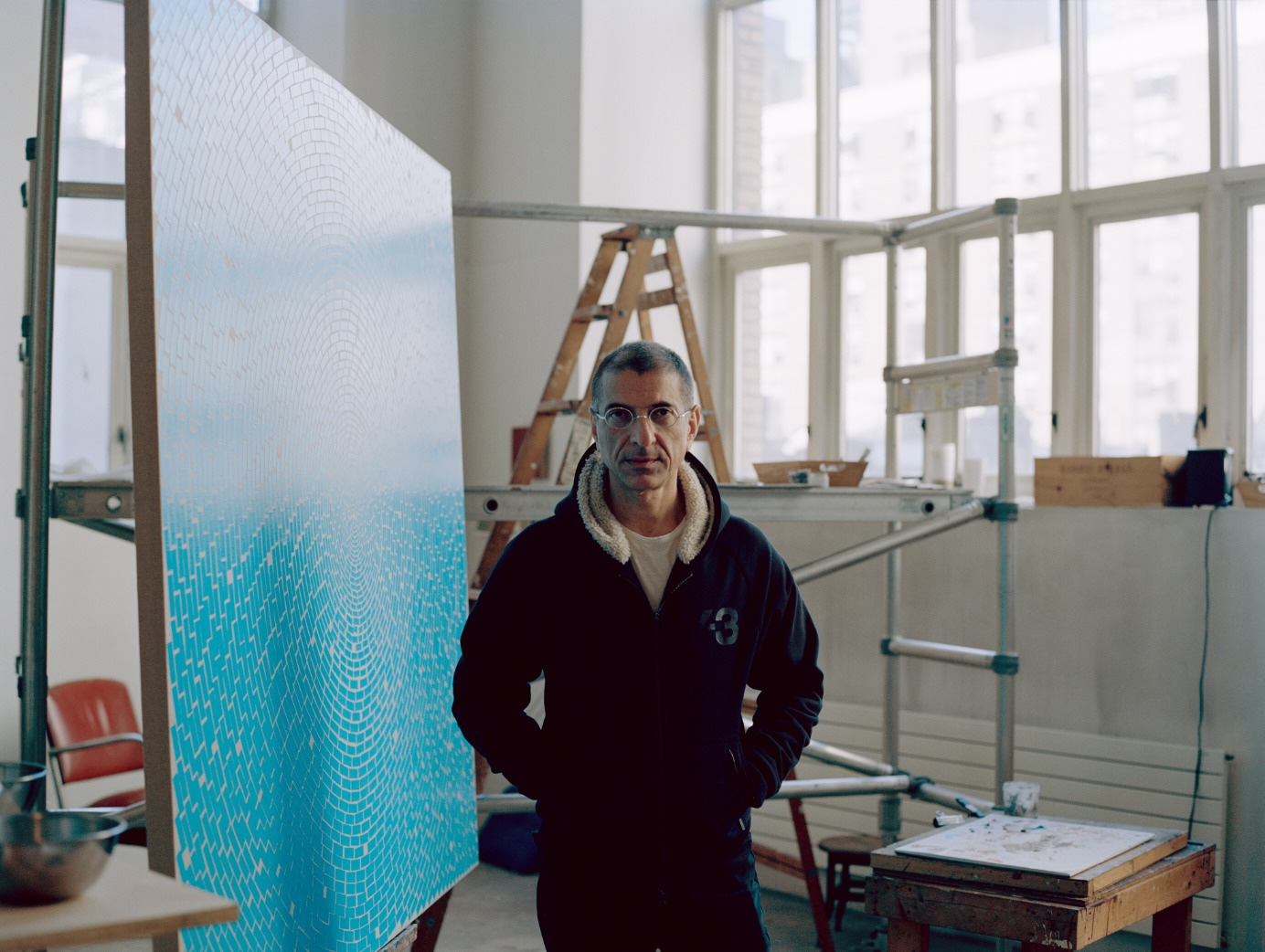
When Art Summit Magazine visited his New York studio, the atmosphere was meditative. The walls were lined not only with his monumental works but also with hundreds of books—poetry, philosophy, art history, and sacred texts from every tradition—testament to Kami’s lifelong devotion to reading and reflection. Surrounded by this quiet library of ideas, he spoke with gentle precision about painting as a spiritual practice. In this conversation, Kami reflects on his fascination with faces, the metaphysical role of geometry, and the spiritual dimension of repetition. His words, like his paintings, lead us toward that inner light where presence and emptiness coexist.
An Interview with Y.Z. Kami
By Carol Real
Before we go deeper into the conceptual side, could you tell me what first drew you to portraiture?
I became a painter in order to paint portraits. Portraiture has always been my main focus. My mother was a painter—very academic—working on portraits, landscapes, and still lifes. When I was a child, maybe five or six years old, I would watch her paint and was fascinated by her ability to capture people. That’s how I began painting portraits myself, and I’ve continued ever since.
Of course, over the decades, things change—your style evolves, your approach shifts. But alongside portraiture, I’ve always been drawn to architecture and geometry. About ten years ago, abstract imagery came to me, which became what I call the Night Paintings. Still, throughout all these years, painting faces has remained my most consistent practice.
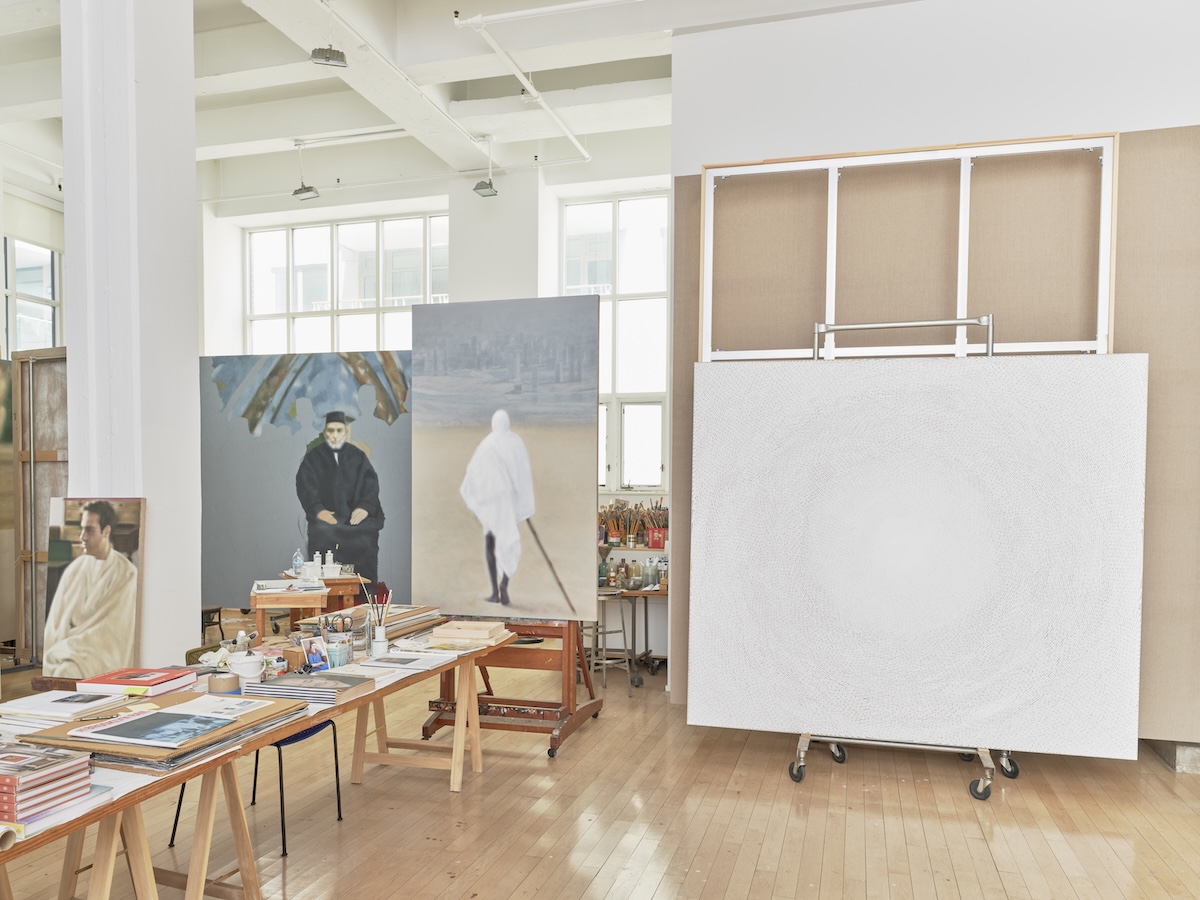
The portraits you see here are directly connected to the Fayum portraits. There’s a very long history of portraiture that stretches from ancient Egypt through Roman and Greek times, to the medieval icons of different traditions and into the Renaissance and beyond. That entire lineage has been at the center of my love for painting.

In your portraits, what is the role of individuality in relation to the universal? Do you aim to reflect the human condition as a whole, or that of a specific being?
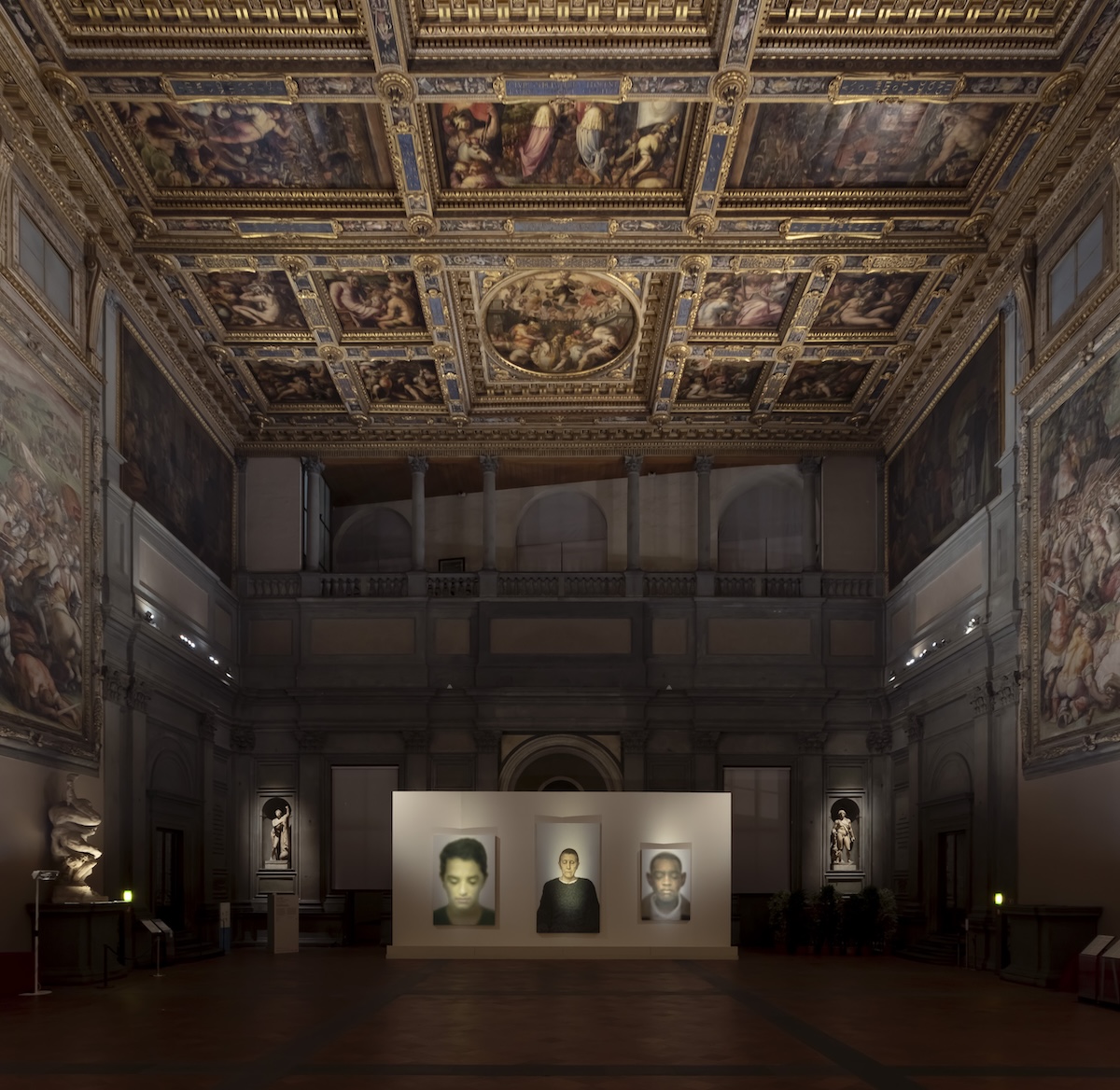
I see it as both—the individual and the universal. My portraits are always of real people, not imaginary faces. They are very individualized.
In this new series, for example (he gestures toward the paintings behind him), the sources are pictures of Fayum portraits from museums. But otherwise, I usually take photographs of people myself and use those as sources for paintings. It is always that specific individual I paint.
At the same time, by painting one person, you are also thinking of that person as a microcosm within the macrocosm. So the universal comes into the picture each time.
You mentioned photography, and many of your portraits begin that way. How does the meaning of an image change when it moves from a photographic medium into painting? What is lost, and what is gained in that process?
When I was growing up and painting as a teenager, I always used a sitter in front of me to paint a portrait. In the 1990s, when I started enlarging the faces—those oversized close-ups of the face—it was not possible to have a model anymore. That was when I began using photography as a source of information for painting.
When you move from the photograph to the painting, it becomes a completely different experience, because painting exists on the surface of the canvas. That is where the meaning lies—in the paint and the brushstrokes.
Each painter, I believe, invents or must invent their own surface. If you look at post-war American paintings, the surface of Jackson Pollock’s paintings is totally different from de Kooning’s, which is totally different from the silkscreen surface of Andy Warhol.
So, the painting is about that surface, which is not photography. When you use a photograph as a source for painting, you enter a completely different realm—a different sensation, a different feeling that comes from the surface itself.

In many of your paintings, the eyes are either open or closed. The act of closing the eyes seems to carry many layers of meaning. Do you think of it as a gesture or metaphor for introspection, or as a way of accessing a perception that transcends the physical?
Probably both. The closed eyes started in my paintings in the late 1990s. Those were probably the first works I did with closed eyes. That was when I encountered Buddhist techniques of meditation. I began practicing meditation and sometimes went on retreats, observing people seated with their eyes closed or gazing downward, in a meditative state or trying to be in one.
It was very different from my earlier experience. All my life, the sitter was always looking directly at me with open eyes, and the eyes were always the center of the painting. I always start a portrait with the eyes, working as much as I can on them before moving to the rest of the face.
With closed eyes, it becomes a completely different experience. The whole surface of the face becomes the field of exploration. The eyes are no longer the main focus—they are as important as the forehead or any other part of the face. I became very fascinated by that, and I explored it further.
I’ve painted many works depicting men and women with closed eyes, but that doesn’t mean I no longer paint open eyes. The new ones are all with eyes open. That’s just how it started, and how it developed.

Geometry in your work seems to carry a sense of mystery. Do you see it as a pathway to the infinite in your paintings, or perhaps as a limitation of imagination?
Geometry is probably the foundation of my Dome paintings and the Endless Prayers series. It is an illusion, or perhaps a point toward the idea of infinity.
I call them “domes,” but in reality, they are not domes! An actual dome has perspective. When you look at one, the center is far away, and gradually the bricks or mosaics become larger and larger.
In my Dome paintings, there is no perspective. They start from a central point and expand cyclically. The size of the elements—whatever they are—remains the same. So the pattern can go on and on, without limit. The pattern continues until it reaches the edge of the canvas, but it could go on beyond it. Geometry—the circles, the geometric rectangles, the squares—represents repetition, and that repetition is the idea of infinity. It can go on and on.
So in this idea of infinity, there is always the notion of transcendence.
That repetition seems to be at the center of your work, right?
The repetition that you see—very clearly in the Dome series, but also in the portraits and the hands—for example, this man you see here has been painted repeatedly. Repetition is like a mantra that is repeated again and again. It’s the same thing: repeating a word or a formula. And here, it’s the repetition of a square or a rectangle, the repetition of an image.
Your White Domes paintings often seem to dissolve into pure light. What does it mean to you that the source of illumination also appears as a void? How do you see this ambiguity affecting the viewer’s perception?
I see it, or I try to convey, that in The White Domes, the light comes from the center and emanates outward. But what you refer to as a void is also valid.
In Zen Buddhism, they speak of śūnyatā—that nothingness from which everything comes and to which everything returns. So that void can be understood in that sense.
White and black have long been understood in art beyond their physical properties, as metaphors for silence, fullness, or absence. Could the white in The White Domes be seen not as emptiness, but as a kind of fullness—a presence rather than a void?
Interesting. In different mystical traditions, both in the West and in the East, the divine is often described by those who have had the experience as pure light. I am only imagining it, since I don’t pretend to have had that kind of experience, but it is said to be a light that is absolute white. Next to it, the light of the sun is like candlelight. It is so absolute, so white—whiter than white.
In Endless Prayers, language becomes a visual spiral. What happens when language detaches from its communicative function and becomes pure form, when it transcends meaning?
In Endless Prayers, as you mentioned, I use text within a geometric and architectural composition that refers to domes—domes as a metaphor for the heavens. The texts I use are poems or prayers that come from different traditions: some are in Persian, others in Hebrew, Arabic, Sanskrit, and Aramaic, including the Lord’s Prayer. It’s not about the text itself, not about reading or following it. And yet, it’s not pure form either, because the text remains present, even though it’s cut into rectangular fragments to fit the composition. I believe the energy of the text stays there.

Which philosophical, poetic, or spiritual voices continue to influence you? Is there perhaps a figure, often overlooked, who has deeply shaped your artistic vision—a philosopher, a poet, or a spiritual guide?
The ones that have stayed with me since my teenage years are poets. Over time, different poets have become more important at different moments in my life, but there are two Persian poets I have always read: Hafez, from the 14th century, and Rumi, from the 13th century. They have been a constant presence.
There are others as well—Persian poets and also poets from other traditions. I love Cavafy, I love Rimbaud, I love Rilke, and others. I have also always had an interest in comparative religion, both Eastern and Western, and in sacred texts from different traditions. Those writings continue to resonate with me.
Your Persian heritage and Western education seem to coexist in your work. Do you see them as forces in tension, or as a synthesis that has allowed you to create a new visual language?
I grew up in a family in Iran that was also exposed to Western culture. My mother, as I mentioned, was a painter working in the European academic tradition. As a teenager, I traveled with my parents to Europe and visited museums, so being exposed to Western culture was part of my upbringing. It never felt foreign to me. At the same time, I was an Iranian growing up in Iran, so these two worlds always coexisted within me.
In the Night Paintings, the solid, the liquid, and the gaseous seem to merge at a threshold between the material and the immaterial. What do those transitions reveal about the ephemeral and changing nature of existence?
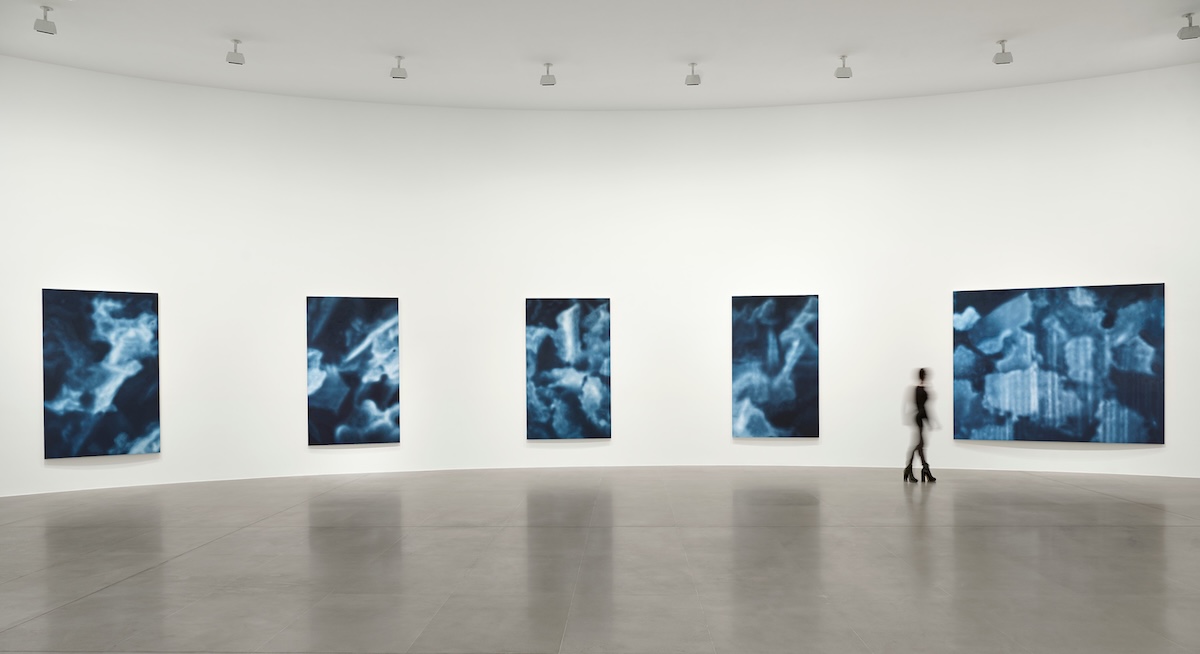
I started the Night Paintings around 2017. They were first exhibited at Gagosian in Rome in 2020. These images came to me in a very strange way, almost out of nowhere. For about a year before I started to paint them, I was completely perplexed, wondering where they came from and why they should be painted!
It happened that during that period, I was reading William Blake’s poetry. Although the images do not resemble Blake’s paintings in any way, something in that reading must have stayed with me. A couple of the paintings are even titled Night Painting for William Blake.
I call them Night Paintings because they are all painted with indigo oil paint—mainly indigo, along with white. Indigo in all its shades, pure indigo. It is said that indigo is the color of the sky on a moonless night—a deep blue that is both dark and quite mysterious.
As you said, these forms developed almost like images from dreams. There are moments in dreams that are completely abstract, when you sense forms that feel real but cannot quite be distinguished. The Night Paintings have that same quality for me—a state between form and formlessness, presence and disappearance.
All images courtesy of the artist © Y.Z. Kami and Gagosian.
Edited by Kristen Evangelista.
Interview conducted in October 2025 and condensed for clarity.