By Carol Real
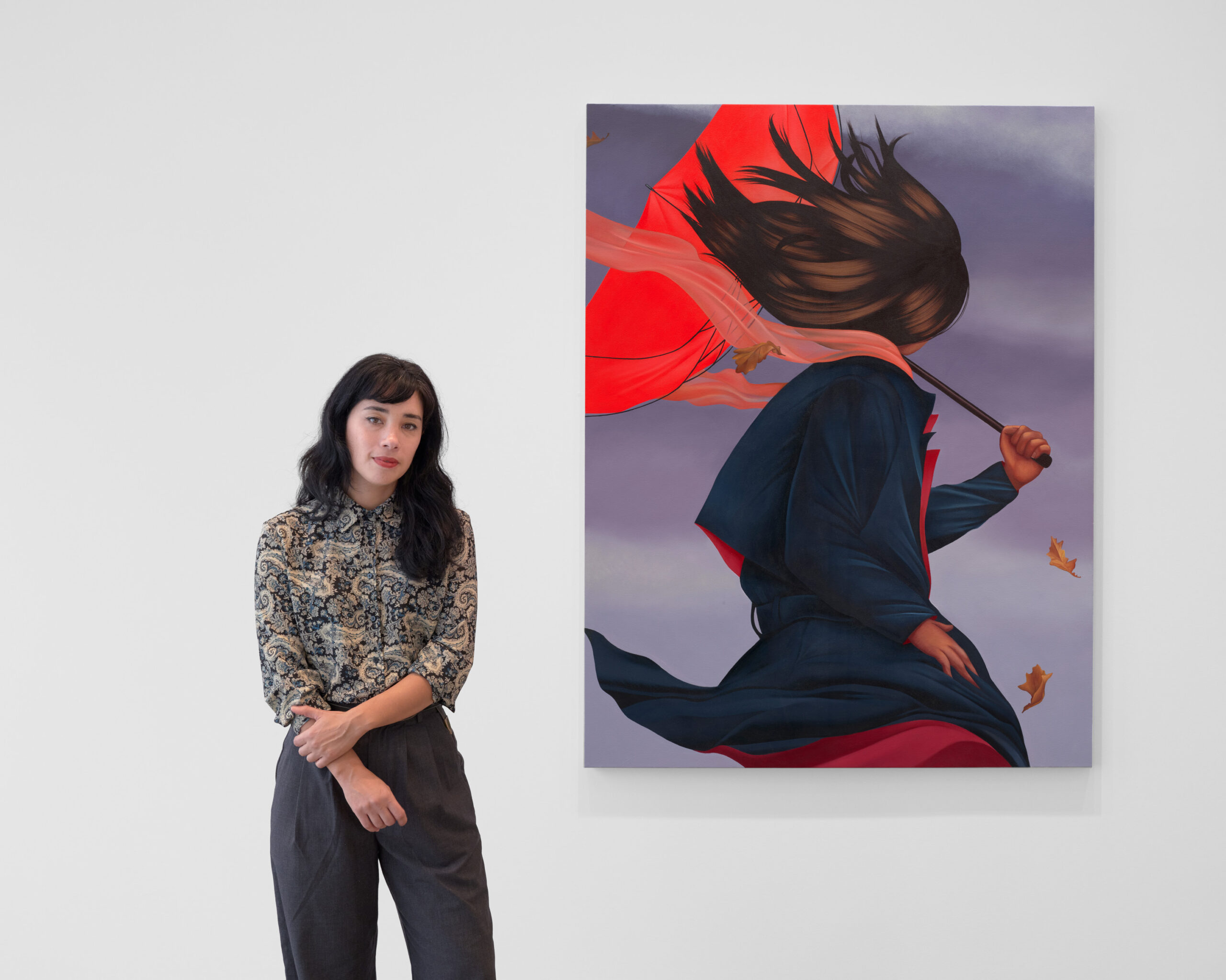
Before the opening of UNREAL, her first New York exhibition with Gagosian, Julie Curtiss speaks with Art Summit about aging in the city, the possibilities of darkness, and the human experience expressed through painting.
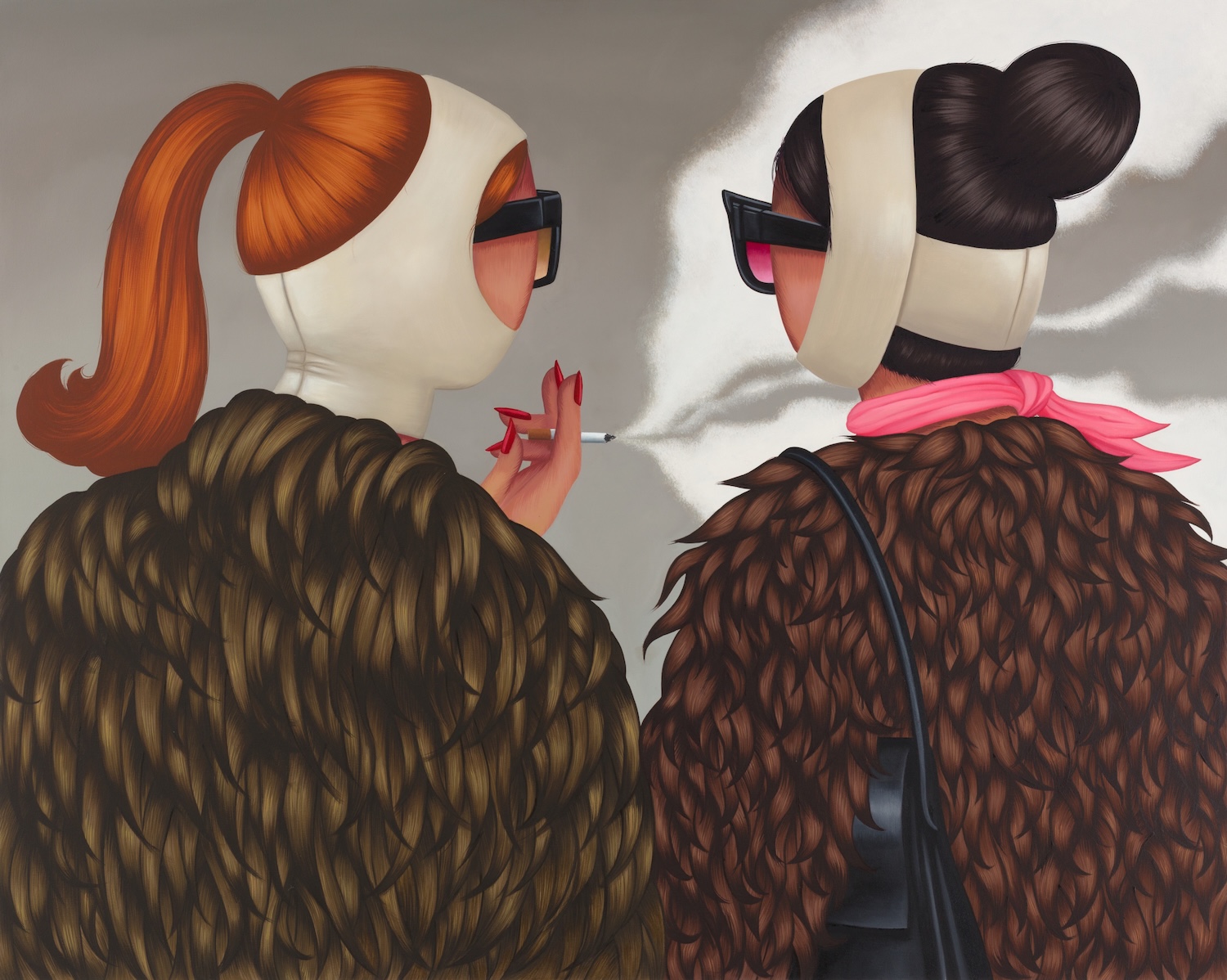
In Julie Curtiss’s Makeover (2026), two women wear fur coats, sunglasses, and postoperative compression masks. Their faces are concealed, yet the scene makes a particular social world legible through its accessories and rituals. Cosmetic surgery, usually understood as a private intervention, enters the public life of the street. The work of constructing an appearance becomes an appearance of its own.
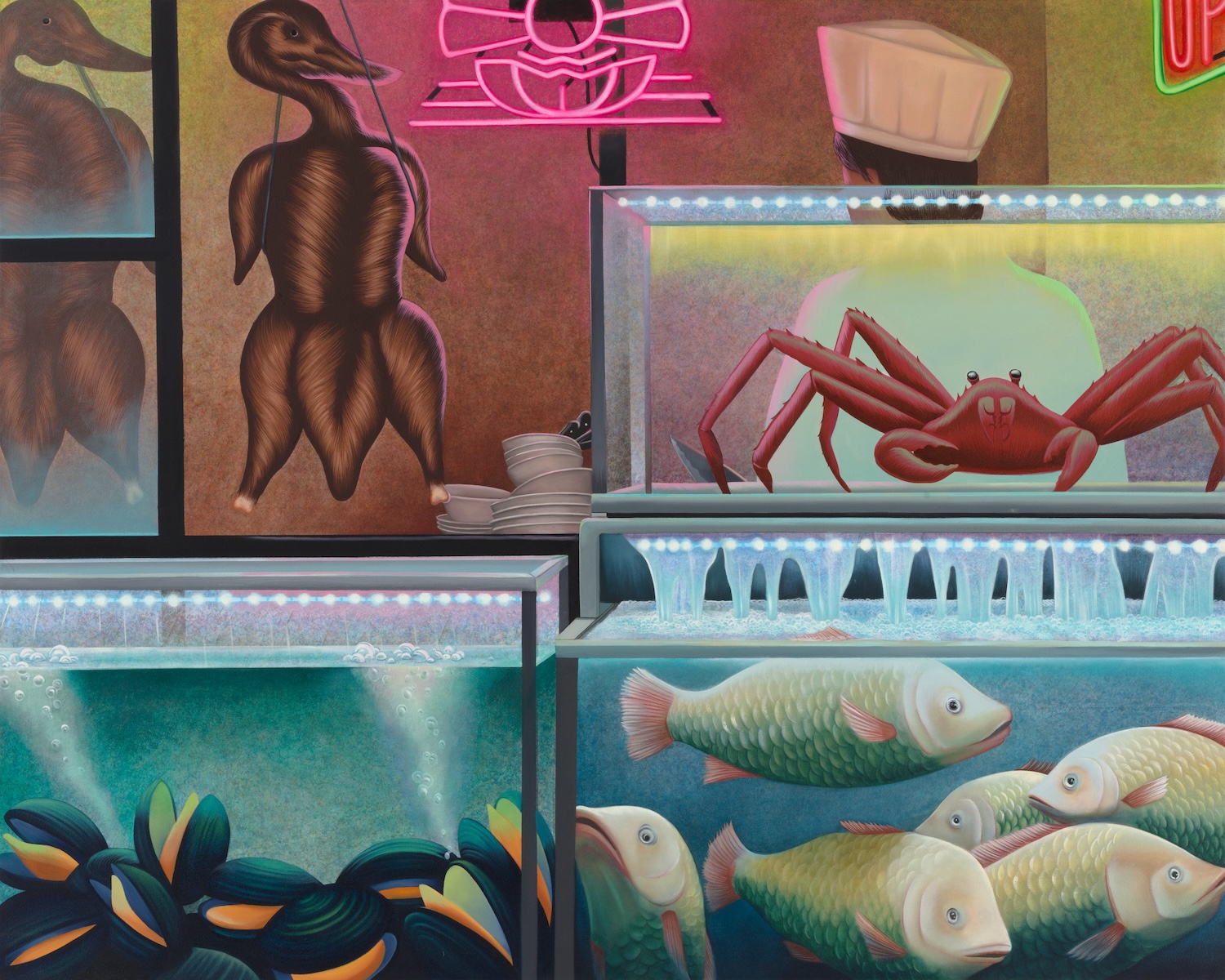
The painting provided the starting point for UNREAL, opening November 10th at Gagosian in New York. Across laundromats, apartments, bodegas, and restaurant kitchens, Curtiss approaches the city through encounters that hover between observation and invention. These settings retain the specificity of recognizable places while accommodating events that disturb their apparent order. An elephant appears inside a bodega. A struggle between a squid and a whale moves from the ocean depths into a bedroom.
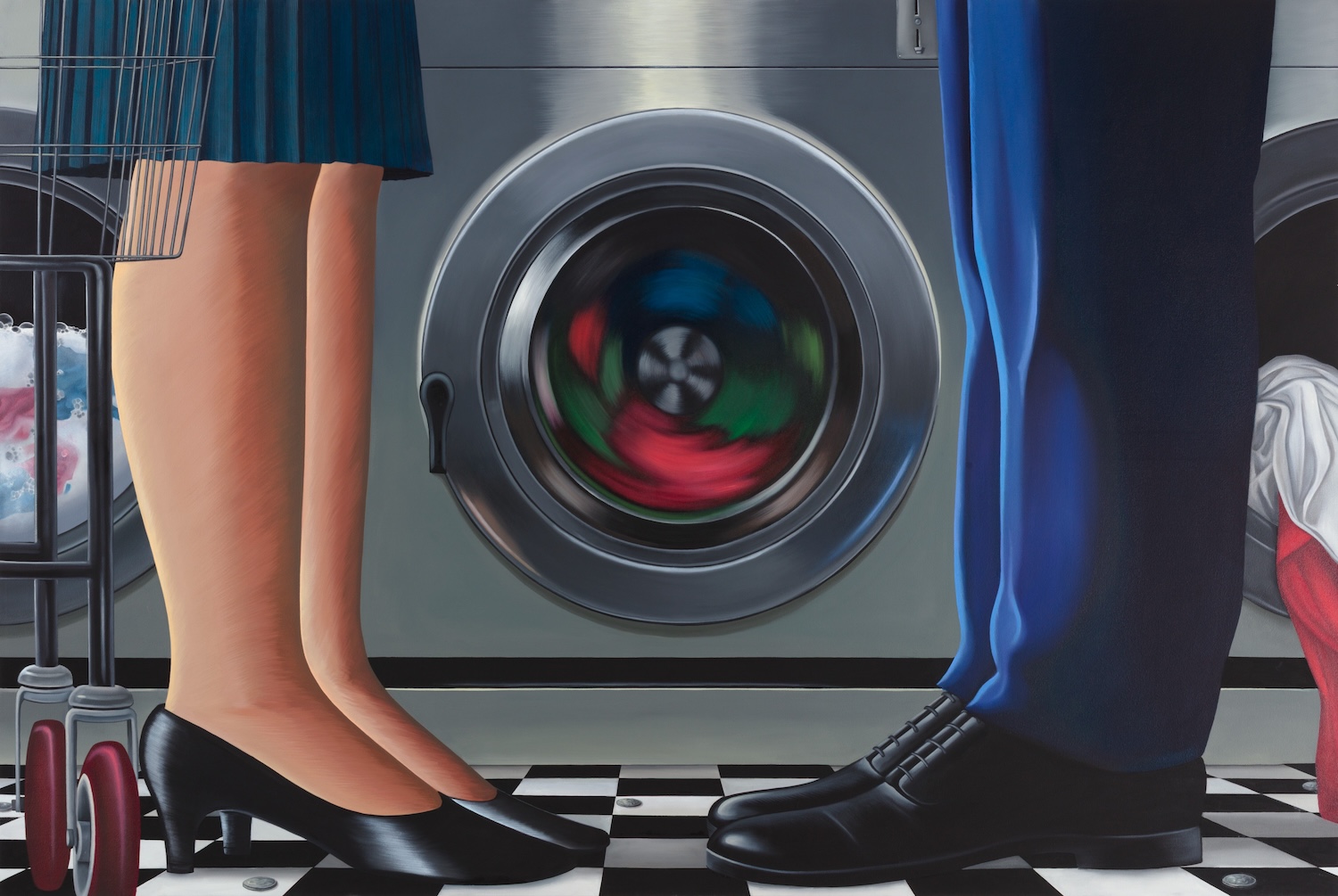
Curtiss’s cropped compositions and concealed faces place demands on the viewer. Without facial expressions to guide us, attention shifts toward gestures, surfaces, and the charged interactions between bodies. In Dirty Laundry (2026), shoes and the geometry of a laundromat carry the tension of an encounter. In Kitchen Appendages (2026), a partially visible figure shares the composition with appliances, steam, and food. Everyday spaces become a portrait assembled from sensory clues.
Born in Paris in 1982, Curtiss draws on a visual vocabulary informed by the Chicago Imagists, Ukiyo-e, and European painting. Her patterned hair, compressed spaces, and transformations between human and object have often drawn comparisons to Surrealism. For this exhibition, she proposes magical realism as a closer point of reference: the ordinary remains recognizable even as its underlying logic unravels.
That instability has a material dimension. Curtiss describes an increasing interest in worn surfaces and in the experience of growing older in New York. Bodies and buildings participate in cycles of maintenance, deterioration, and repair. Her account of the city gives the exhibition’s humor an undertow of vulnerability.
In the following conversation, Curtiss discusses how these paintings developed, the ambivalence of belonging to New York, and the uncertain future of images made by human hands.
In Conversation with Julie Curtiss
UNREAL is your first New York exhibition with Gagosian. Does that context change the way you think about the show? When you began working on these paintings, did you feel you wanted to introduce a different side of your practice, or make a statement about where your work is now?
For an artist, exhibiting on home turf is always a bit of a challenge. You know all your acolytes will be there, and you don’t want to disappoint them. In a way, the stakes are higher. But as much as I wanted to rise to the occasion, I also know that the works have a life of their own, and trying to control it isn’t productive.
I’ve always been the kind of artist who does first and thinks later! There always needs to be an element of the unexpected in what I do. While there is a starting point, I never get too attached to the outcome. It’s when it comes to hanging the show that the final narrative takes shape and things fall into place.
Looking at UNREAL alongside your earlier work, what feels different to you? I’m curious whether something shifted in the studio, in your palette, the way you use light, or even in how you build a painting. Was there a moment when you realized the work was moving somewhere new?
My practice is constantly evolving, so it’s hard for me to say whether there’s been a major departure from my previous work. I tend to work in a branching way, with one painting prompting another. Inspiration comes from different places within myself, and the results can vary aesthetically, with each tendril growing in its own direction. Along the way, small discoveries are made.
I wanted to express what it feels like to grow older in the city. I was drawn to the idea of wear and tear, both thematically and aesthetically. I’ve been paying more attention to surfaces in some of the paintings, particularly worn-out surfaces.
Another challenge was to paint my darkest painting yet, inspired by one of the windows at the Museum of Natural History depicting the epic battle between a squid and a whale, which I relocated to a bedroom. I learned a lot from that painting, and I want to explore this realm of darkness, from which my scenes could emerge. I could see how working with values rather than chroma could simplify my visual language.
A few people have also mentioned that there seems to be more movement in this particular series compared to my previous body of work, which has a very characteristic stillness.
New York is very present in this show, but it’s not quite the New York we know. Laundromats, bodegas, apartments, restaurant kitchens, familiar places that somehow feel strange. What made you want to turn toward the city now, and how much of what we’re seeing comes from things you’ve actually observed versus things you’ve imagined?
The first painting I set aside for the show, Makeover, was started in 2025. It depicts two Upper East Side ladies—or at least, that’s who they represent in my mind—who have just undergone cosmetic surgery and are hanging out in their fur coats and post-surgery headbands. It felt like such a New York painting to me that I couldn’t imagine it being understood in quite the same way anywhere else. And that’s what prompted the rest of the show.
I realized I wanted to make a New York show about New York, with different vignettes of the city, a bit like journal entries. Except that sometimes the line between life as it is and life as it’s fantasized or internalized becomes blurred. So I’d say the paintings are a bit like the way a film director explores thoughts and feelings vicariously, through imagined characters and situations.
As I mentioned earlier, I wanted to capture the ambivalence LCD Soundsystem expresses in the song “New York, I Love You but You’re Bringing Me Down.” I feel a kinship with the city’s sidewalks, which seem to be in a constant state of decay and repair. Living here is like wearing a worn-out shoe: it’s comfortable, but always on the verge of falling apart. It’s something I love and loathe at the same time.
You’ve said that “nothing feels real right now,” particularly with AI and artificial images becoming part of everyday life. As a painter, does that make you think differently about what a handmade image can do? Has it changed what you want from painting, or what you want the viewer to believe when they stand in front of one?
This year has been quite uncomfortable on a personal level, but I think I can also say that the pace of everything—cultural, technological, political, and so on—has been unsettling for everyone.
I struggled to find a sense of cohesion in what I was doing. I felt there were too many different directions, and I was wondering if they would come together as a show in the end. This year felt UNREAL, and I think that comes through in the paintings. In the past, I was often boxed in with the Surrealists, but with this body of work, I’d identify more with magical realism. I’m engaging with the ordinary while the very fabric of reality seems to be coming undone, and unseen forces are beginning to make their way through it.
With AI imagery and our relationship to reality, we’re in a crisis. There is distrust; the survival instinct is kicking in. It’s hard to feel as optimistic and enthusiastic as we might once have been. This sense of suspicion—that things aren’t what they seem—has always been central to my work.
As AI imagery becomes ubiquitous, I suppose we have to wonder whether the skills involved in making art will continue to be valued. From a human perspective, pursuing art is an endless source of enrichment. But the fear is that human art will be devalued by AI’s seemingly endless capacity to recycle, imitate, and generate.
From my standpoint, I see my paintings as an interface between my body, mind, and soul and the external world. We often talk about how artworks expand our vision, but what if their power lies in the opposite—in being reduced, distilled, and as suggestive as the single human being who dreamed them up? A handmade painting holds the lived experience, the bodily aches, and the biases of its maker. And perhaps, for all its flaws, that’s our salvation.
I suppose the question is: what happens when technology evolves to the point of a Philip K. Dick kind of future? And then what?
Exhibition Information
Julie Curtiss: UNREAL
November 10–December 19, 2026
Gagosian
541 West 24th Street, New York